The Bible and the Flat-ish, Still Earth
This is a follow up for those who’ve already read “The BIG Post“. (That’s a prerequisite.) The original work began as Rob Skibas’ “The Bible and The Still Flat Earth”. Of course like EVERY SINGLE OTHER “FLAT EARTHER”, he was just another lying piece of shite working for the tribe as controlled opposition. That said, as the reader shall see, his work entailed the tedious and meticulous gathering of nearly, if not every, biblical English verse in existence regarding what God Himself Told us about our home called Earth. So, all of that and much of his factual commentary remains but with a few important additions and key differences including;
a. Per EVERY authentic scripture on Earth, God means God and His Name is YHWH, not jezeus, jehova or any purple dinosaur.
b. The LIARS behind all the flat AND tiny Earth LIES are satanic jews who Rob and ALL other popular “flat earthers” are assigned with the task of protecting. (It’s the only reason they were allowed to make money and remain on any social media platform, or even to remain alive for that matter! In Robs’ case, that ended in 2020 when he “doubled up” and also went public against vaccines which the satanic jews are using to depopulate/mass murder We the People) And the most important difference with this, the revised and corrected version of his article is . . .
c. Due to the very well known 8″ of curvature per mile, we speak not of a “Flat Earth” but rather a “Flat-ish Earth” with the biblical “Earth Circle” being just a very small portion of the surface area on a much larger globe.
This distinction is the last bastion of Truth regarding all the Flat Earth discussions and activities once again being popularized and managed by the satanic jews in their ongoing roles as “controlled opposition”.
Before we begin, we must remind all Christians about why the real basis of the Flat Earth Controversy is important to nail down. Indeed, why does this matter? Well, just for beginners;
- Genesis is the foundation of ALL that we believe in the Bible to be true. If Genesis is wrong, then it ALL crumbles under a faulty foundation. Genesis says NOTHING – zip, zero, nadda – about the Earth being set in motion (orbit or rotation) around the sun. In fact, the sun doesn’t even show up until AFTER the Earth is already in place with life ALREADY existing. Genesis says the sun, moon and stars were created after the Earth Circle was defined and the firmament was put in place to separate the waters. Thus, we have a system enclosed by the firmament (of unknown thickness), within which the sun, moon and stars move, NOT the Earth. You can Yoga-Jujitsu-Wrestle Mania twist and distort the text into pretzels all you want, but it changes NOTHING.
- What we are told is that the Flat-ish, Enclosed Earth system is center stage in some sort of a grand theater which is surrounded by 7 Heavens that are chock full of “others”. Those being the angels, possibly still some jinn (like lucifer before his fall), and of course God Who “Took His Throne” above it all.
- So, Earth is the main attraction and when one realizes that we’ve all been LIED TO about virtually everything regarding it and that all the scriptural creation stories actually fit like proverbial gloves, there can be NO argument as to whether or not there is a Creator. None. His Existence could not possibly become more blatantly obvious than in the factual reconciliation of the model that The Creator of it all Has provided to us in all the authentic scriptures.
- IF the Flat-ish Enclosed Earth model were known by all, evolution goes out the window, forever.
- IF the Flat-ish Enclosed Earth model were known by all, then we would NOT EVER trust NASA or the government about ANYTHING and we will finally be able to fully trust YHWHs’ Word as our sole source for Truth and stop trying to bend and manipulate it to fit false paradigms.
- If heliocentricity IS false, then Scripture IS True. If Scripture IS True, and can thus be taken literally, why should we not take it just as literal when it describes the earth as fixed, not moving, set on a foundation of pillars, carved as a “circle” enclosed under a dome that meets the surface around its perimeter?
Those are just a few basic reasons for why this is an extremely important subject. Scriptures are chock full of many more reasons and most of them revolve around the simple idea that Truth reigns supreme.
Romans 1:18 For God’s wrath is being revealed from heaven against all the ungodliness and wickedness of those who in their wickedness suppress the truth.
1 Timothy 6:20-21 O Timothy, keep that which is committed to thy trust, avoiding profane and vain babblings, and oppositions of science falsely so called: Which some professing have erred concerning the faith. Grace be with thee. Amen.
This particular “quest for truth” however is very challenging as it literally requires that you search for truth in a sea of lies. To make matters worse, literally everything in this world as well as in the Church seems to be against you with all issues of such immense importance. In fact, never before have I seen any subject stir up such intense emotions. Indeed. You may already be experiencing them within yourself. Or you may have experienced it from those you’ve begun to share your thoughts with so far. Whatever the case may be, we all have a certain level of cognitive dissonance to overcome, and this subject carries with it some of the most raw emotions of anything we’ve ever encountered in all our lives.
Along with those emotions comes an all too common question: Why??? What’s the motivation to lie to us about the shape and nature of our world? To me, the motivation is quite clear:
- First get people to doubt YHWHs’ Word by destroying the very foundation of our Bible: Genesis – specifically the Creation account.
- Set up a new paradigm, where God is out and “science” is in. Evolution removes YHWH from the equation.
- When evolution finally runs its course and becomes utterly bankrupt, introduce the idea of “Intelligent Design” but deny the True Designer His due credit and place it rather on “Ancient Aliens” of whom lucifer himself is among. He and his fallen accomplices are in fact the primary actors in this and every other great charade of LIES we as a species have ever encountered since the beginning.
- Promote the Ancient Alien/luciferian theme as much as possible in all forms of media by perpetuating the concept of Earth as a tiny “blue marble” orbiting an average sun in an average galaxy among trillions of other galaxies in an ever expanding Universe. With so much “potential for life to exist” in such a vast expanse, the idea of alien scientists being our creators seems a lot more plausible over time and heavy indoctrination.
- The stage is set for our “alien creators” to return and bestow upon us their “miracles, signs and wonders” in order to convince us all the more that the only True religion of Monotheism is false. We then put our trust in them. Finally, when Gods’ Last Messenger does arrive, we are all convinced that He is the enemy and our deceived world gathers together to make war with lucifer against Him. This of course ends with all those who’ve bought into the lies, burning in Hell for Eternity, exactly as prophesied by ALL of Gods’ authentic prophets.
Let’s start with what the Bible has to say concerning the topic of our world and its place in the cosmos.
ALLOWING THE BIBLE TO SPEAK FOR ITSELF
Below are a number of Bible verses without commentary. Unless otherwise noted, all of the Scriptures are taken from the KJV. Pretending you have never heard of a globe or even a flat-ish earth before, let’s just allow the Bible to speak for itself. Read them over a couple of times, asking the Holy Spirit to reveal to you what they mean. Without forcing an interpretation based on preconceived notions, meditate on them and ask yourself, “What is the Bible really showing me concerning the nature of the heavens, the earth, the sun, moon and stars?”
The Scriptures below are arranged by topics in order to set the stage for what will follow. The book of Job is before Genesis as many (if not the vast majority) of scholars believe it is the oldest book of the Bible. We have emphasized words in bold for more consideration as we read.
Scriptures concerning the nature of the heavens/sky above and their relationship to the earth:
Job 9:
- Which shaketh the earth out of her place, and the pillars thereof tremble.
- Which commandeth the sun, and it riseth not; and sealeth up the stars.
- Which alone spreadeth out the heavens, and treadeth upon the waves of the sea.
Job 22:14 Thick clouds are a covering to him, that he seeth not; and he walketh in the circuit {Hebrew:
“chug”} of heaven.
Job 22:14 (HCSB) Clouds veil Him so that He cannot see, as He walks on the circle of the sky.
Job 22:14 (ASV) Thick clouds are a covering to him, so that he seeth not; And he walketh on the vault of heaven.
Job 26:
- He stretcheth out the north over the empty place, and hangeth the earth upon nothing.
- He bindeth up the waters in his thick clouds; and the cloud is not rent under them.
- He holdeth back the face of his throne, and spreadeth his cloud upon it.
- He hath compassed the waters with bounds, until the day and night come to an end.
- The pillars of heaven tremble and are astonished at his reproof.
- He divideth the sea with his power, and by his understanding he smiteth through the proud. 13 By his spirit he hath garnished the heavens; his hand hath formed the crooked serpent.
Job 37:18 Hast thou with him spread out the sky, which is strong, and as a molten looking glass?
Genesis 1:
- In the beginning God created the heaven and the earth.
- And the earth was without form, and void; and darkness was upon the face of the deep. And the Spirit of God moved upon the face of the waters.
- And God said, Let there be light: and there was light.
- And God saw the light, that it was good: and God divided the light from the darkness.
- And God called the light Day, and the darkness he called Night. And the evening and the morning were the first day.
- And God said, Let there be a firmament in the midst of the waters, and let it divide the waters from the waters.
- And God made the firmament, and divided the waters which were under the firmament from the waters which were above the firmament: and it was so.
- And God called the firmament Heaven. And the evening and the morning were the second day.
Genesis 7:11 In the six hundredth year of Noah’s life, in the second month, the seventeenth day of the month, the same day were all the fountains of the great deep broken up, and the windows of heaven were opened.
Genesis 8:2 The fountains also of the deep and the windows of heaven were stopped, and the rain from heaven was restrained;
2 Samuel 22:8 Then the earth shook and trembled; the foundations of heaven moved and shook, because he was wroth.
Psalm 19:1 The heavens declare the glory of God; and the firmament sheweth his handywork.
Psalm 29:10 YHWH sitteth upon the flood; yea, the LORD sitteth King for ever.
Psalm 78:
- Therefore YHWH heard this, and was wroth: so a fire was kindled against Jacob, and anger also came up against Israel;
- Because they believed not in God, and trusted not in His salvation:
- Though He had commanded the clouds from above, and opened the doors of heaven, 24 And had rained down manna upon them to eat, and had given them of the corn of heaven.
25 Man did eat food from angels: He sent them food to the full.
Psalm 104:
- Bless the Lord, O my soul. O Lord my God, thou art very great; thou art clothed with honour and majesty.
- Who coverest thyself with light as with a garment: Who stretchest out the heavens like a curtain: 3 Who layeth the beams of his chambers in the waters: Who maketh the clouds His chariot: Who walketh upon the wings of the wind:
Psalm 148:4 Praise Him, ye heavens of heavens, and ye waters that be above the heavens.
Proverbs 8:27 When He prepared the heavens, I was there: when He set {Hebrew: “chaqaq”} a compass {Hebrew: “chug”} upon the face of the depth:
Proverbs 8:27 (ESV) When He established the heavens, I was there, When He inscribed a circle on the face of the deep.
Isaiah 13:13 Therefore I will shake the heavens, and the earth shall remove out of her place, in the wrath of the Lord of hosts, and in the day of His fierce anger.
Isaiah 40:22 It is He that sitteth upon the circle of the earth, and the inhabitants thereof are as grasshoppers; that stretcheth out the heavens as a curtain, and spreadeth them out as a tent to dwell in:
Isaiah 40:22 (ISV) He’s The One Who sits above the disk of the earth, and its inhabitants are like grasshoppers. He’s The One Who stretches out the heavens like a curtain, and spreads them like a tent to live in,
Isaiah 44:24 Thus saith YHWH, thy redeemer, and He that formed thee from the womb, I am He that maketh all things; that stretcheth forth the heavens alone; that spreadeth abroad the earth by Myself;
Isaiah 45:12 I have made the earth, and created man upon it: I, even My Hands, have stretched out the heavens, and all their host have I commanded.
Isaiah 48:13 Mine hand also hath laid the foundation of the earth, and my right hand hath spanned the heavens: when I call unto them, they stand up together.
Isaiah 66:1 Thus saith YHWH, The heaven is My Throne, and the earth is My Footstool: where is the house that ye build unto Me? and where is the place of My rest?
Ezekiel 1:26 And above the firmament that was over their heads was the likeness of a throne, as the appearance of a sapphire stone: and upon the likeness of the throne was the likeness as the appearance of a man above upon it.
Amos 9:6 It is he that buildeth His stories in the heaven, and hath founded His troop in the earth; He that calleth for the waters of the sea, and poureth them out upon the face of the earth: YHWH is his name.
Amos 9:6 (ASV) it is He that buildeth His chambers in the heavens, and hath founded His Vault upon the earth; He that calleth for the waters of the sea, and poureth them out upon the face of the earth; YHWH is His Name.
Amos 9:6 (ESV) it is he that buildeth his chambers in the heaven, and hath founded his vault upon the earth; he that calleth for the waters of the sea and poureth them out upon the face of the earth; YHWH is His Name.
Amos 9:6 (Darby) It is he that buildeth his upper chambers in the heavens, and hath founded his vault upon the earth; he that calleth for the waters of the sea, and poureth them out upon the face of the earth: YHWH is His Name.
Amos 9:6 (NASB) The One who builds His upper chambers in the heavens And has founded His vaulted dome over the earth, He who calls for the waters of the sea And pours them out on the face of the earth, YHWH is His Name.
Scriptures concerning the nature of the earth below the firmament:
Job 9:6 Which shaketh the earth out of her place, and the pillars thereof tremble.
Job 26:7 He stretcheth out the north over the empty place, and hangeth the earth upon nothing.
Job 26:10 He hath compassed the waters with bounds, until the day and night come to an end.
Job 28:24 For He looketh to the ends of the earth, and seeth under the whole heaven;
Job 37:3 He directeth it under the whole heaven, and His lightning unto the ends of the earth.
Job 38:
- Then YHWH answered Job out of the whirlwind, and said,
- Who is this that darkeneth counsel by words without knowledge?
- Gird up now thy loins like a man; for I will demand of thee, and answer thou me.
- Where wast thou when I laid the foundations of the earth? Declare, if thou hast understanding.
- Who hath laid the measures thereof, if thou knowest? Or who hath stretched the line upon it?
- Whereupon are the foundations thereof fastened? Or who laid the corner stone thereof;
- When the morning stars sang together, and all the sons of God (aka Jinn) shouted for joy?
Job 38:13 That it might take hold of the ends of the earth, that the wicked might be shaken out of it?
Genesis 1:
- And God said, Let the waters under the heaven be gathered together unto one place, and let the dry land appear: and it was so.
- And God called the dry land Earth; and the gathering together of the waters called he Seas: and God saw that it was good.
- And God said, Let the earth bring forth grass, the herb yielding seed, and the fruit tree yielding fruit after his kind, whose seed is in itself, upon the earth: and it was so.
- And the earth brought forth grass, and herb yielding seed after his kind, and the tree yielding fruit, whose seed was in itself, after his kind: and God saw that it was good. And the evening and the morning were the third day.
- Samuel 2:8 He raiseth up the poor out of the dust, and lifteth up the beggar from the dunghill, to set them among princes, and to make them inherit the throne of glory: for the pillars of the earth are YHWHs’, and He hath set the world upon them.
- Samuel 22:16 And the channels of the sea appeared, the foundations of the world were discovered, at the rebuking of YHWH , at the blast of the breath of His Nostrils.
1 Chronicles 16:30 Fear before him, all the earth: the world also shall be stable, that it be not moved.
Psalm 18:15 Then the channels of waters were seen, and the foundations of the world were discovered at thy rebuke, O Lord, at the blast of the breath of Thy nostrils.
Psalm 75:3 The earth and all the inhabitants thereof are dissolved: I bear up the pillars of it. Selah.
Psalm 93:1 YHWH reigneth, He is clothed with majesty; YHWH is clothed with strength, wherewith He hath girded Himself: the world also is stablished, that it cannot be moved.
Psalm 96:
- O worship YHWH in the beauty of holiness: fear before Him, all the earth.
- Say among the heathen that YHWH reigneth: the world also shall be established that it shall not be moved: He shall judge the people righteously.
- Let the heavens rejoice, and let the earth be glad; let the sea roar, and the fullness thereof.
Psalm 102:25 Of old hast Thou laid the foundation of the earth: and the heavens are the work of Thy Hands.
Psalm 104:
- Who laid the foundations of the earth, that it should not be removed for ever.
- Thou coveredst it with the deep as with a garment: the waters stood above the mountains.
- At Thy rebuke they fled; at the voice of Thy Thunder they hasted away.
- They go up by the mountains; they go down by the valleys unto the place which Thou hast founded for them.
- Thou hast set a bound that they may not pass over; that they turn not again to cover the earth.
Psalm 136:
6 To him that stretched out the earth above the waters: for His mercy endureth for ever.
Proverbs 8:
27 When He prepared the heavens, I (Gabriel) was there: when He set {Hebrew: “chaqaq”} a compass {Hebrew: “chug”} upon the face of the depth: – (ESV) When He established the heavens, I was there, When He inscribed a circle on the face of the deep.
28 When He established the clouds above: when He strengthened the fountains of the deep: 29 When He gave to the sea His decree, that the waters should not pass His commandment: when He appointed the foundations of the earth:
Isaiah 11:12 And He shall set up an ensign for the nations, and shall assemble the outcasts of Israel, and gather together the dispersed of Judah from the four corners of the earth.
Isaiah 13:13 Therefore I will shake the heavens, and the earth shall remove out of her place, in the wrath of the Lord of hosts, and in the day of His fierce anger.
Isaiah 40:22 It is He that sitteth upon the circle of the earth, and the inhabitants thereof are as grasshoppers; He that stretcheth out the heavens as a curtain, and spreadeth them out as a tent to dwell in:
Isaiah 40:22 (ISV) He’s The One who sits above the disk of the earth, and its inhabitants are like grasshoppers. He’s The One Who stretches out the heavens like a curtain, and spreads them like a tent to live in,
Isaiah 43:6 I’ll say to the north, ‘Give them up’! and to the south, ‘Don’t keep them back!’ Bring My sons from far away and My daughters from the ends of the earth—
Daniel 4:
10 Thus were the visions of mine head in my bed; I saw, and behold a tree in the midst of the earth, and the height thereof was great.
11 The tree grew, and was strong, and the height thereof reached unto heaven, and the sight thereof to the end of all the earth:
Jonah 2:6 I went down to the bottoms of the mountains; the earth with her bars was about me for ever: yet hast Thou brought up my life from corruption, O YHWH my God.
Matthew 4:
- Again, the devil taketh him up into an exceeding high mountain, and sheweth him all the kingdoms of the world, and the glory of them;
- And saith unto him, All these things will I give thee, if thou wilt fall down and worship me.
Matthew 24:31 And He shall send his angels with a great sound of a trumpet, and they shall gather together his elect from the four winds, from one end of heaven to the other.
John 17:24
Father, I desire that they also, whom thou hast given me, may be with me where I am, to behold my glory which thou hast given me in thy love for me before the foundation of the world.
Revelation 1:7 Behold, he cometh with clouds; and every eye shall see him, and they also which pierced him: and all kindreds of the earth shall wail because of him. Even so, Amen.
Revelation 7:1 And after these things I saw four angels standing on the four corners of the earth, holding the four winds of the earth, that the wind should not blow on the earth, nor on the sea, nor on any tree.
Revelation 20:8 He will go out to deceive Gog and Magog, the nations at the four corners of the earth, and gather them for war. They are as numerous as the sands of the seashore.
Scriptures concerning the nature of the sun, moon and stars:
Job 38:7 When the morning stars sang together, and all the sons of God shouted for joy?
Genesis 1:
- And God said, Let there be lights in the firmament of the heaven to divide the day from the night; and let them be for signs, and for seasons, and for days, and years:
- And let them be for lights in the firmament of the heaven to give light upon the earth: and it was so. And God made two great lights; the greater light to rule the day, and the lesser light to rule the night: he made the stars also.
- And God set them in the firmament of the heaven to give light upon the earth,
- And to rule over the day and over the night, and to divide the light from the darkness: and God saw that it was good.
Deuteronomy 4:19 And lest thou lift up thine eyes unto heaven, and when thou seest the sun, and the moon, and the stars, even all the host of heaven, shouldest be driven to worship them, and serve them, which the Lord thy God hath divided unto all nations under the whole heaven.
Joshua 10:13 And the sun stood still, and the moon stayed, until the people had avenged themselves upon their enemies. Is not this written in the book of Jasher? So the sun stood still in the midst of heaven, and hasted not to go down about a whole day.
Judges 5:20 They fought from heaven; the stars in their courses fought against Sisera.
Psalms 19:
1 The heavens declare the glory of God; and the firmament sheweth His Handywork.
2 Day unto day uttereth speech, and night unto night sheweth knowledge.
3 There is no speech nor language, where their voice is not heard.
4 Their line is gone out through all the earth, and their words to the end of the world. In them hath He set a tabernacle for the sun,
5 Which is as a bridegroom coming out of his chamber, and rejoiceth as a strong man to run a race.
6 His going forth is from the end of the heaven, and His circuit unto the ends of it: and there is nothing hid from the heat thereof.
Psalm 136:
7 To Him that made great lights: for His mercy endureth for ever:
8 The sun to rule by day: for His mercy endureth for ever:
9 The moon and stars to rule by night: for His mercy endureth for ever.
Psalm 147:4 He telleth the number of the stars; He calleth them all by their names.
Psalm 148:3 Praise ye Him, sun and moon: praise Him, all ye stars of light.
Ecclesiastes 1:5 The sun also ariseth, and the sun goeth down, and hasteth to its place where it arose.
Isaiah 13:9 Behold, the day of YHWH cometh, cruel both with wrath and fierce anger, to lay the land desolate: and He shall destroy the sinners thereof out of it.
10 For the stars of heaven and the constellations thereof shall not give their light: the sun shall be darkened in his going forth, and the moon shall not cause her light to shine.
Isaiah 38:8 Behold, I will bring again the shadow of the degrees, which is gone down in the sun dial of Ahaz, ten degrees backward. So the sun returned ten degrees, by which degrees it was gone down.
Ezekiel 32:
7 And when I shall put thee out, I will cover the heaven, and make the stars thereof dark; I will cover the sun with a cloud, and the moon shall not give her light.
8 All the bright lights of heaven will I make dark over thee, and set darkness upon thy land, saith YHWH the Lord.
Daniel 8:10 And it waxed great, even to the host of heaven; and it cast down some of the host and of the stars to the ground, and stamped upon them.
Joel 2:10 The earth shall quake before them; the heavens shall tremble: the sun and the moon shall be dark, and the stars shall withdraw their shining:
Joel 3:15 The sun and the moon shall be darkened, and the stars shall withdraw their shining.
Amos 5:26 But ye have borne the tabernacle of your Moloch and Chiun your images, the star of your god, which ye made to yourselves.
Habakkuk 3:11 The sun and moon stood still in their habitation: at the light of thine arrows they went, and at the shining of thy glittering spear.
Matthew 24:29 Immediately after the tribulation of those days shall the sun be darkened, and the moon shall not give her light, and the stars shall fall from heaven, and the powers of the heavens shall be shaken:
Acts 7:43 Yea, ye took up the tabernacle of Moloch, and the star of your god Remphan, figures which ye made to worship them: and I will carry you away beyond Babylon.
1 Corinthians 15:41 There is one glory of the sun, and another glory of the moon, and another glory of the stars: for one star differeth from another star in glory.
Revelation 1:20 The mystery of the seven stars which thou sawest in my right hand, and the seven golden candlesticks. The seven stars are the angels of the seven churches: and the seven candlesticks which thou sawest are the seven churches.
Revelation 6:13 And the stars of heaven fell unto the earth, even as a fig tree casteth her untimely figs, when she is shaken of a mighty wind.
Revelation 8:
10 And the third angel sounded, and there fell a great star from heaven, burning as it were a lamp, and it fell upon the third part of the rivers, and upon the fountains of waters;
11 And the name of the star is called Wormwood: and the third part of the waters became wormwood; and many men died of the waters, because they were made bitter.
12 And the fourth angel sounded, and the third part of the sun was smitten, and the third part of the moon, and the third part of the stars; so as the third part of them was darkened, and the day shone not for a third part of it, and the night likewise.
Revelation 9:1 And the fifth angel sounded, and I saw a star fall from heaven unto the earth: and to him was given the key of the bottomless pit.
Revelation 12:4 And his tail drew the third part of the stars of heaven, and did cast them to the earth: and the dragon stood before the woman which was ready to be delivered, for to devour her child as soon as it was born.
Again, applying no preconceived notions upon the text, how do you imagine a newcomer to the Scriptures would view the heavens, earth, sun, moon and stars just based on what you’ve read here? Would they see a spinning, heliocentric, globular Earth in an ever expanding universe? Or would they see something vastly different? Clearly, without any doubt whatsoever – they would see something completely different from what we’ve all been taught to believe. If this is not already abundantly clear to you, the remainder of this document will explain why.
THE BIBLE AND THE “STILL” FLAT-ISH EARTH
The Bible and therefore God Himself, are telling us, in no uncertain terms, that we live on a “still” (as in stationary), flat-ish, enclosed earth. The following explains why;
Genesis 1:1 In the beginning God created the heavens and the earth.
This is an introductory statement. It establishes the fact that Elohim is the creator of everything. From there, the text goes on to describe how He did it:
2 The earth was without form, and void; and darkness was on the face of the deep. And the Spirit of God was hovering over the face of the waters.
3 Then God said, “Let there be light”; and there was light. 4 And God saw the light, that it was good; and God divided the light from the darkness.
5 God called the light Day, and the darkness He called Night. So the evening and the morning were the first day.
6 Then God said, “Let there be a firmament in the midst of the waters, and let it divide the waters from the waters.”
7 Thus God made the firmament, and divided the waters which were under the firmament from the waters which were above the firmament; and it was so.
8 And God called the firmament Heaven. So the evening and the morning were the second day.
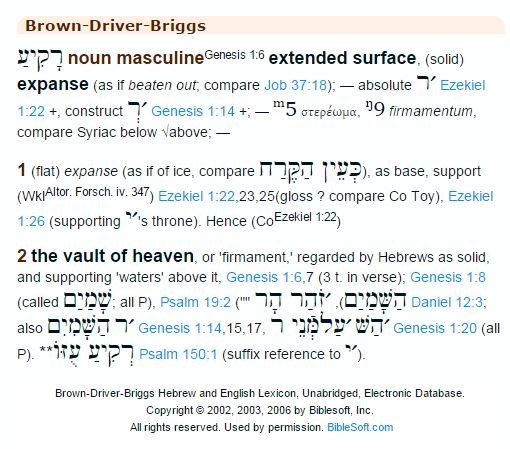
Out of nowhere we have water. We never see anything about it being created. It’s just there as a result of the opening statement and it is “deep.” The Hebrew word “heaven” is shamyim. The word for water is, mayim. Thus it would appear that water and heaven have some sort of connection to one another right from the start. After the creation of “light” as day and the declaration that “dark” is night, a “firmament” appears to separate the mayim waters above from the mayim waters below. The word for “firmament” is raqia. This is where things start to get interesting. Note how Brown-Drive-Briggs defines it:
There is a principle of Biblical hermeneutics known as the “Law of First Mention” (or some derivation of that), which states that you look at how a word or concept is first introduced and then consider how it is understood and used elsewhere in light of that first use. The website, biblicalresearch.info describes this law as follows:
IV. The fourth rule of interpretation is THE LAW OF FIRST MENTION.
A. The meaning of the law of First Mention: The Law of First Mention may be said to be the principle that requires one to go to that portion of the Scriptures where a doctrine is mentioned for the first time and to study the first occurrence of the same in order to get the fundamental inherent meaning of that doctrine. B. When this law is applied the simple precedes the complex.
-
- A history of the development of anything will show that it sprang from something in the very simplest form (for example the steamship; airplane; automobile)
- In the Scriptures the growth and development of ideas and doctrine might be illustrated by some simple word.
- Throughout the history of a term it may have increased its meaning and undergone certain changes, yet the basic, original, fundamental thought is seldom lost.
- The fundamental concept usually controls or is dominant in coloring every shade of idea expressed by a term in its current usage Source: http://www.biblicalresearch.info/page48.html
II. The Meaning Of The Law Of First Mention
The law of first mention may be said to be the principle that requires one to go to that portion of the Scriptures where a doctrine is mentioned for the first time and to study the first occurrence of the same in order to get the fundamental inherent meaning of that doctrine. When we thus see the first appearance, which is usually in the simplest form, we can then examine the doctrine in other portions of the Word that were given later. We shall see that the fundamental concept in the first occurrence remains dominant as a rule, and colors all later additions to that doctrine. In view of this fact, it becomes imperative that we understand the law of first mention.
Source: http://www.biblicalresearch.info/page56.html
With this in mind, in Genesis 1, we have a description of something that would become the sky overhead. But Genesis is not the first Holy Spirit inspired book of Scripture. Job is. Therefore, regarding the sky, let’s consider how the oldest book of the Bible describes it:
Job 37:18 Hast thou with him spread out the sky, which is strong, and as a molten looking glass?
If Job is in fact the oldest book, then Genesis doesn’t establish the law of first mention, Job does. Either way, you end up with the same conclusion, backed by the two “beginning” books of the Bible. Genesis begins the Torah, which is the foundation of our whole Bible. Job, being the oldest written text in the Bible fully supports what we see in Genesis. But in Job, we see that the sky is spread out like a molten looking glass, or as other translations render it a cast metal (bronze) mirror:
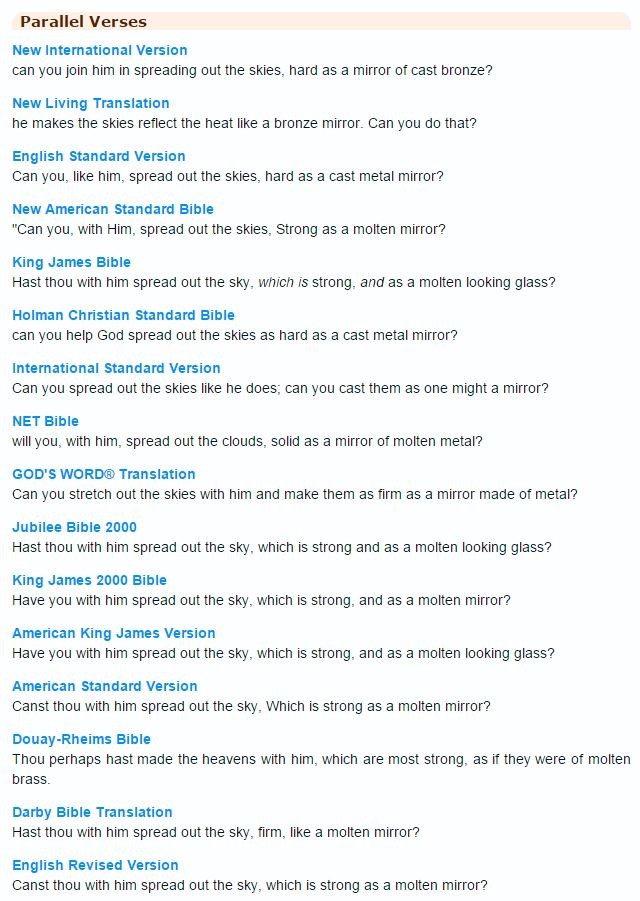
So much for the notion that the sky/heaven above us consists of just gaseous air. We apparently have a hard canopy somewhere, very high above us. OK. Let’s keep testing that idea. Why does it need to be so hardened?
Ezekiel 1:26 And above the firmament that was over their heads was the likeness of a throne, as the appearance of a sapphire stone: and upon the likeness of the throne was the likeness as the appearance of a man above upon it.
So, YHWHs’ throne sits on top of the firmament, which is described as being cast like a metal mirror! The idea of YHWHs’ throne being atop the “firmament” is not unusual:
Isaiah 66:1 Thus saith YHWH , The heaven is My Throne, and the earth is My Footstool: where is the house that ye build unto Me? And where is the place of My rest?
What kind of “footstool” spins around 1,000 mph, while running away at 66,600 mph? They have made YHWHs’ “throne” sound like a ride at Disney World. Conversely, the prophets seem to be telling us – point-blank – that YHWHs’ throne sits atop the firmament, which would thus have His feet planted on the hard canopy that surrounds the earth. While the firmament is not technically the “earth” as in the mass upon which land and sea are found, the firmament is part of the system that makes the earth what it is. This brings us to the Scripture many have tried to use concerning the shape of the earth:
Isaiah 40:22 It is he that sitteth upon the circle of the earth, and the inhabitants thereof are as grasshoppers; He that stretcheth out the heavens as a curtain, and spreadeth them out as a tent to dwell in:
There is a difference between a circle and a globe/sphere/ball. An ice-skating rink is a circle. We skate on it, going round and round, but never, up, over and around. It is not a sphere. It is an enclosure in the shape of a circle. So also it would appear that the Earth is. Check out the Septuagint’s version of this same verse:
Isaiah 40:22 (LXX) [It is] He that comprehends the circle of the earth, and the inhabitants in it are as grasshoppers; He that set up the heaven as a chamber, and stretched [it] out as a tent to dwell in:
Without trying to literally force a globe onto this text, it describes a circular earth that has a heaven (beaten metallic expanse) set up over it as a “chamber,” which is stretched out like a “tent” for us to dwell in. This is describing an enclosed system! How enclosed is it? Let’s go back to Genesis…
Genesis 1:
14 And God said, Let there be lights in the firmament of the heaven to divide the day from the night; and let them be for signs, and for seasons, and for days, and years:
15 And let them be for lights in the firmament of the heaven to give light upon the earth: and it was so.
16 And God made two great lights; the greater light to rule the day, and the lesser light to rule the night: he made the stars also.
17 And God set them in the firmament of the heaven to give light upon the earth,
18 And to rule over the day and over the night, and to divide the light from the darkness: and God saw that it was good.
Please note that the sun, moon and stars are placed inside the enclosed “firmament.” Now, as believers in the globe model our whole lives and strong advocates for the Creation account of our origins, we have always talked a lot about the firmament as sort of an “ice canopy” that surrounded the Earth before the Flood. Many times, we have heard the wonderful work of Dr. Carl Baugh and Kent Hovind among others to support that view. But, we subscribed to their model, because like them, always believed in the globe representation of the Earth floating in space. See what we’ve done there? We’ve forced our own preconceived ideas onto the text as a result of listening to fellow men of God who have done the same thing. But that’s not what Moses wrote! He didn’t say God placed the sun, moon and stars around the Earth. He said YHWH placed those things in the firmament that was dividing the waters above from the waters below.
Just to be sure, let’s go back and read Genesis 1, verses 1 through 18 to keep the continuity clear:
Genesis 1:
- In the beginning God created the heaven and the earth.
- And the earth was without form, and void; and darkness was upon the face of the deep. And the Spirit of God moved upon the face of the waters.
- And God said, Let there be light: and there was light.
- And God saw the light, that it was good: and God divided the light from the darkness.
- And God called the light Day, and the darkness he called Night. And the evening and the morning were the first day.
- And God said, Let there be a firmament in the midst of the waters, and let it divide the waters from the waters.
- And God made the firmament, and divided the waters which were under the firmament from the waters which were above the firmament: and it was so.
- And God called the firmament {that divided the waters} Heaven. And the evening and the morning were the second day.
- And God said, Let the waters under the heaven be gathered together unto one place, and let the dry land appear: and it was so.
- And God called the dry land Earth; and the gathering together of the waters called he Seas: and God saw that it was good.
- And God said, Let the earth bring forth grass, the herb yielding seed, and the fruit tree yielding fruit after his kind, whose seed is in itself, upon the earth: and it was so.
- And the earth brought forth grass, and herb yielding seed after his kind, and the tree yielding fruit, whose seed was in itself, after his kind: and God saw that it was good.
- And the evening and the morning were the third day.
- And God said, Let there be lights in the firmament of the heaven to divide the day from the night; and let them be for signs, and for seasons, and for days, and years:
- And let them be for lights in the firmament of the heaven to give light upon the earth: and it was so.
- And God made two great lights; the greater light to rule the day, and the lesser light to rule the night: he made the stars also.
- And God set them in the firmament of the heaven to give light upon the earth,
- And to rule over the day and over the night, and to divide the light from the darkness: and God saw that it was good.
In verses 7 & 8, we see that essentially the “pocket of air,” which is dividing water above from water below is called “Heaven.” Verse 9 is talking about stuff under that heaven, which would become the land, vegetation and seas. This is all inside the dome! Verse 14 never takes us outside of that setting. Nor does the rest of the chapter. The entire chapter from verse 8 forward is “under the dome”! If you’ve never noticed that before, it’s because we weren’t looking for it. But there it is. Plain as day… if not imposing preconceived notions upon the text.
Indeed, this “under the dome” view of the earth was not foreign to the ancients. Many ancient cultures had some variation of this general view of the earth:
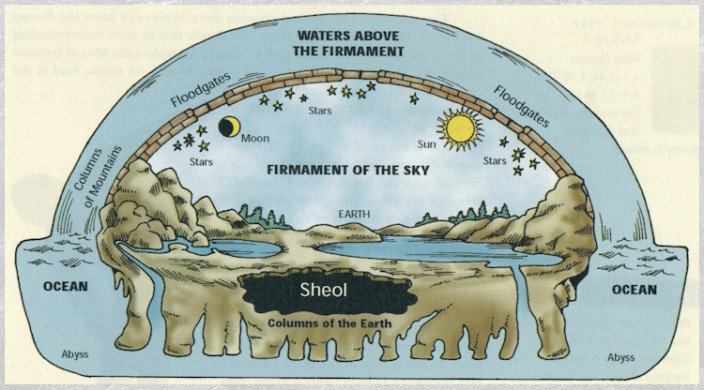
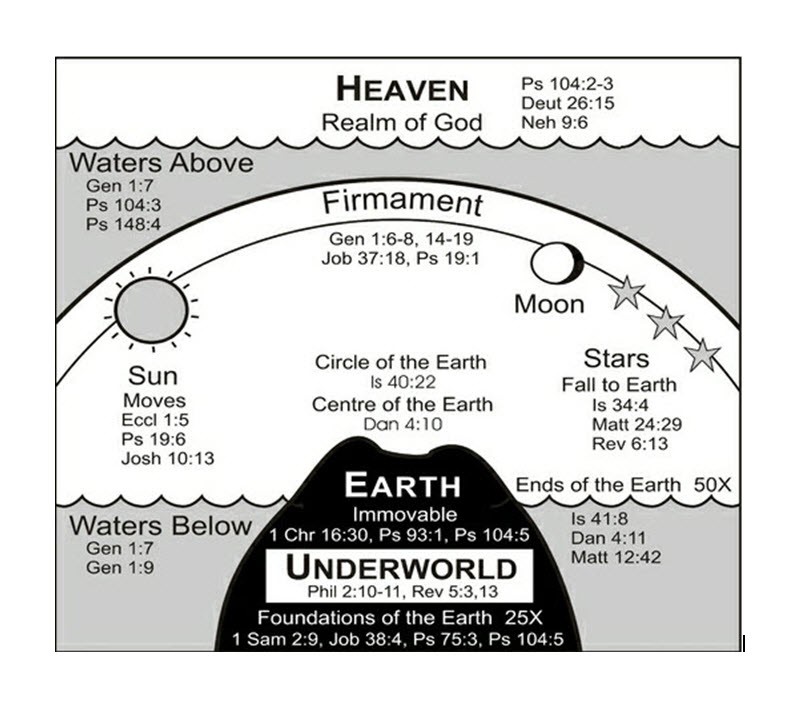
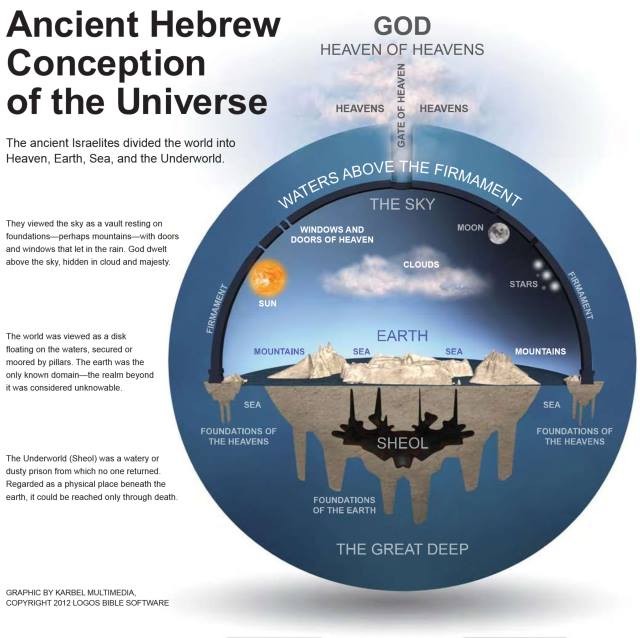
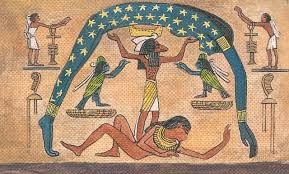
In ancient Egypt, their god “Nut” was depicted as the canopy. You will see similar depictions to the one on the right all over Egyptian iconography. It kind of makes one wonder if this is why people think you are “nuts” for believing in what we’re talking about here. LOL! Maybe it’s just a coincidence. Regardless, an online article, titled “The Flat-Earth Bible,” written by Robert J. Schadewald, © 1987, 1995, states some things worth quoting here:
The Biblical cosmology is never explicitly stated, so it must be pieced together from scattered passages. The Bible is a composite work, so there is no a priori reason why the cosmology assumed by its various writers should be relatively consistent, but it is. The Bible is, from Genesis to Revelation, a flat-ish-earth book.
This is hardly surprising. As neighbors, the ancient Hebrews had the Egyptians to the southwest and the Babylonians to the northeast. Both civilizations had flat-ish-earth cosmologies. The Biblical cosmology closely parallels the Sumero-Babylonian cosmology, and it may also draw upon Egyptian cosmology.
The Babylonian universe was shaped like a modern domed stadium. The Babylonians considered the earth essentially flat (i.e. flat-ish) with a continental mass surrounded by ocean. The vault of the sky was a physical object resting upon the ocean’s waters (and perhaps also upon pillars). Sweet (salt-free) waters below the Earth sometimes manifest themselves as springs. The Egyptian universe was also enclosed, but it was rectangular instead of round. Indeed, it was shaped much like an old-fashioned steamer trunk. (The Egyptians pictured the goddess Nut stretched across the sky as the enclosing dome.) What was the Hebrew view of the universe?
The Order of Creation
The Genesis creation story provides the first key to the Hebrew cosmology. The order of creation makes no sense from a conventional perspective but is perfectly logical from a flat-ish-earth viewpoint. The earth was created on the first day, and it was “without form and void (Genesis 1:2).” On the second day, a vault the “firmament” of the King James version was created to divide the waters, some being above and some below the vault. Only on the fourth day were the sun, moon, and stars created, and they were placed “in” (not “above”) the vault.
The Vault of Heaven
The vault of heaven is a crucial concept. The word “firmament” appears in the King James version of the Old Testament 17 times, and in each case it is translated from the Hebrew word raqiya, which meant the visible vault of the sky. The word raqiya comes from riqqua, meaning “beaten out.” In ancient times, brass objects were either cast in the form required or beaten into shape on an anvil. A good craftsman could beat a lump of cast brass into a thin bowl. Thus, Elihu asks Job, “Can you beat out [raqa] the vault of the skies, as he does, hard as a mirror of cast metal (Job 37:18)?”
Elihu’s question shows that the Hebrews considered the vault of heaven a solid, physical object. Such a large dome would be a tremendous feat of engineering. The Hebrews (and supposedly YHWH Himself) considered it exactly that, and this point is hammered home by five scriptures:
Job 9:8, “…Who by Himself spread out the heavens [shamayim]…”
Psalm 19:1, “The heavens [shamayim] tell out the glory of God, the vault of heaven [raqiya] reveals His Handiwork.”
Psalm 102:25, “…the heavens [shamayim] were Thy Handiwork.”
Isaiah 45:12, “I, with My Own Hands, stretched out the heavens [shamayim] and caused all their host to shine…”
Isaiah 48:13, “…with My Right Hand I formed the expanse of the sky [shamayim]…”
If these verses are about a mere illusion of a vault, they are surely much ado about nothing. Shamayim comes from shameh, a root meaning to be lofty. It literally means the sky. Other passages complete the picture of the sky as a lofty, physical dome. God “sits throned on the vaulted roof of earth [chuwg], whose inhabitants are like grasshoppers. He stretches out the skies [shamayim] like a curtain, he spreads them out like a tent to live in…[Isaiah 40:22].” Chuwg literally means “circle” or “encompassed.” By extension, it can mean roundness, as in a rounded dome or vault. Job 22:14 says God “walks to and fro on the vault of heaven [chuwg].” In both verses, the use of chuwg implies a physical object, on which one can sit and walk. Likewise, the context in both cases requires elevation. In Isaiah, the elevation causes the people below to look small as grasshoppers. In Job, God’s eyes must penetrate the clouds to view the doings of humans below. Elevation is also implied by Job 22:12: “Surely God is at the zenith of the heavens [shamayim] and looks down on all the stars, high as they are.”
This picture of the cosmos is reinforced by Ezekiel’s vision. The Hebrew word raqiya appears five times in Ezekiel, four times in Ezekiel 1:22-26 and once in Ezekiel 10:1. In each case the context requires a literal vault or dome. The vault appears above the “living creatures” and glitters “like a sheet of ice.” Above the vault is a throne of sapphire (or lapis lazuli). Seated on the throne is “a form in human likeness,” which is radiant and “like the appearance of the glory of the Lord.” In short, Ezekiel saw a vision of God sitting throned on the vault of heaven, as described in Isaiah 40:22.
Source: https://www.lhup.edu/~dsimanek/febible.htm
Going back to the Isaiah 40:22 passage, it has been claimed by many that “circle” is a description of the Earth as a globe. As Robert J. Schadewald points out, the Hebrew word used here is “chug” (pronounced “khoog”), but is this the word one would use for a ball-shaped object? No. The word comes from another very similar word, both of which mean:
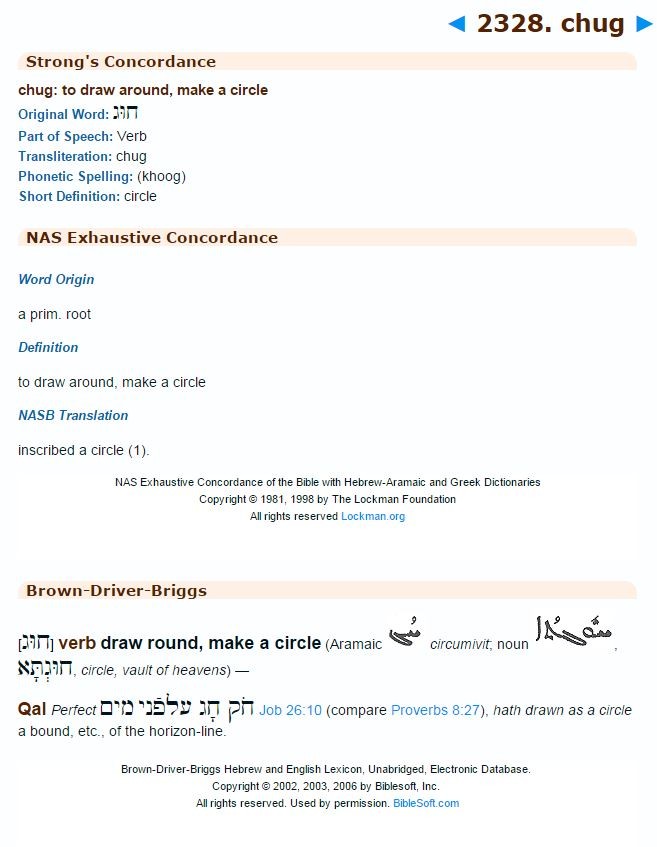
Circle means circle. Not ball. Isaiah clearly knows the difference between a circle and a spherical object. Note that a few chapters prior he uses a completely different word for a ball:
Isaiah 22:18 He will surely violently turn and toss thee like a ball into a large country: there shalt thou die, and there the chariots of thy glory shall be the shame of thy lord’s house.
The Hebrew word Isaiah used for “ball” here is “dur” because, of course you can’t toss a circle (chug). Whereas, of course, a spherical object you can toss. He knew the difference. Therefore, Isaiah 40:22 is a terrible Scripture reference to use as a description of the Earth’s shape being a sphere. But, let’s continue to test this. Where else is “chug” used and how?
Proverbs 8:27 (ESV) When He established the heavens, I (Gabriel) was there, When He inscribed a circle on the face of the deep.
How do you “inscribe a circle” on the face of something to get a ball? It’s only logical the circle is something cut into something else. The Hebrew word the ESV translated into “inscribe” is “chaqaq” which means:
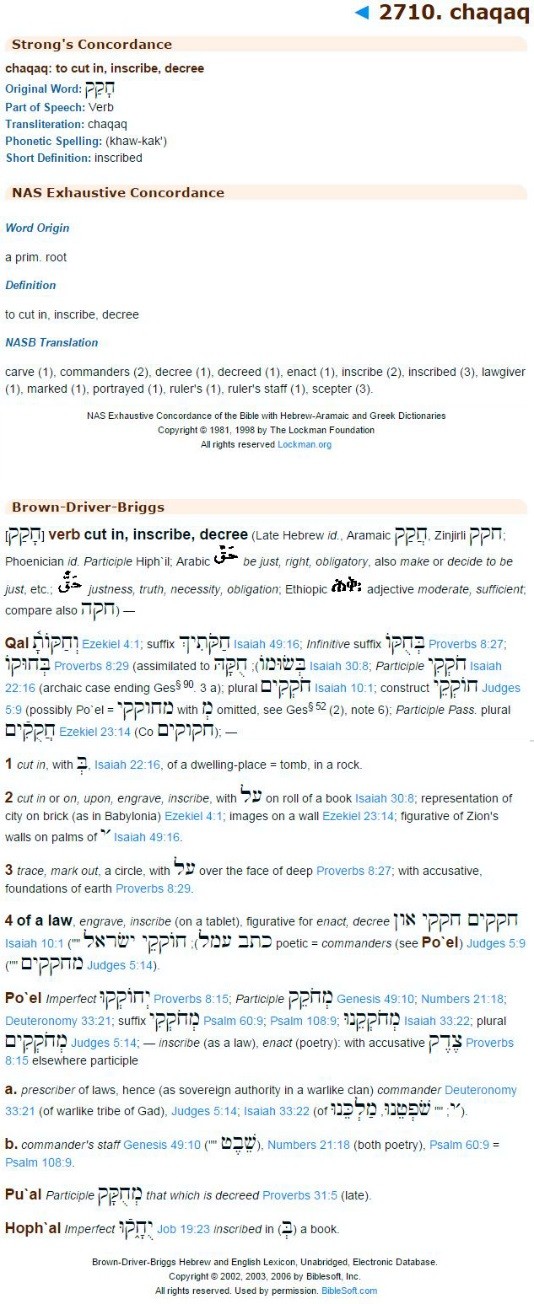
Taking the Law of First Mention into account again, we must realize that there was precedence set for the “circle of the earth” prior to Isaiah writing about it. King Solomon is telling us the “circle” Isaiah would later write about (likely being fully aware of what Solomon wrote) was cut into something that was deep. In Genesis, we saw the waters were deep. Then the Holy Spirit moved across the waters. A firmament was created to separate the waters, then the waters under it were gathered into one place and the dry land “appeared.” Could it be that when, YHWH “carved a circle in the deep,” this was how the waters were divided and the land was revealed? Maybe, but we’re definitely not seeing a ball showing up anywhere in these descriptions. Let’s continue looking at the oldest book of the Bible again:
Job 26:10 (NASB) He has inscribed a circle on the surface of the waters At the boundary of light and darkness.
Job 26:10 (KJV) He hath compassed the waters with bounds, until the day and night come to an end.
The KJV uses the word “compassed” in this verse, but the English words mean the same thing: A circular ring that creates a boundary. In this case, the word translated as “inscribed a circle” in the NASB and “compassed the waters” in the KJV is the same word (chug) used in Isaiah 40:22. So, let’s put all of these parallel Scriptures together in the chronological order of time in which they were written:
Job 26:10 (NASB) He has inscribed a circle on the surface of the waters At the boundary of light and darkness.
Genesis 1 (KJV):
- And the earth was without form, and void; and darkness was upon the face of the deep. And the Spirit of God moved upon the face of the waters.
- And God said, Let there be light: and there was light.
- And God saw the light, that it was good: and God divided the light from the darkness.
- And God called the light Day, and the darkness he called Night. And the evening and the morning were the first day.
- And God said, Let there be a firmament in the midst of the waters, and let it divide the waters from the waters.
- And God made the firmament, and divided the waters which were under the firmament from the waters which were above the firmament: and it was so.
- And God called the firmament {that divided the waters} Heaven. And the evening and the morning were the second day.
- And God said, Let the waters under the heaven be gathered together unto one place, and let the dry land appear: and it was so.
- And God called the dry land Earth; and the gathering together of the waters called he Seas: and God saw that it was good.
Proverbs 8:27 (ESV) When He established the heavens, I was there, When He inscribed a circle on the face of the deep. and finally…
Isaiah 40:22 (KJV) It is He that sitteth upon the circle of the earth, and the inhabitants thereof are as grasshoppers; that stretcheth out the heavens as a curtain, and spreadeth them out as a tent to dwell in:
Here we see Job, Moses and Solomon setting the stage, with Isaiah actually being the last one in this list to write of these things. Based on the Law of First Mention then, we must understand that he is only confirming what has already been said by others before him concerning how YHWH literally carved a circle into the deep. This kind of language does not give us a picture of a ball floating in endless space. Rather it gives us something that looks more along the lines of the following, which depicts the earth as being a circular mass carved into a base of something else that has 4 corners:
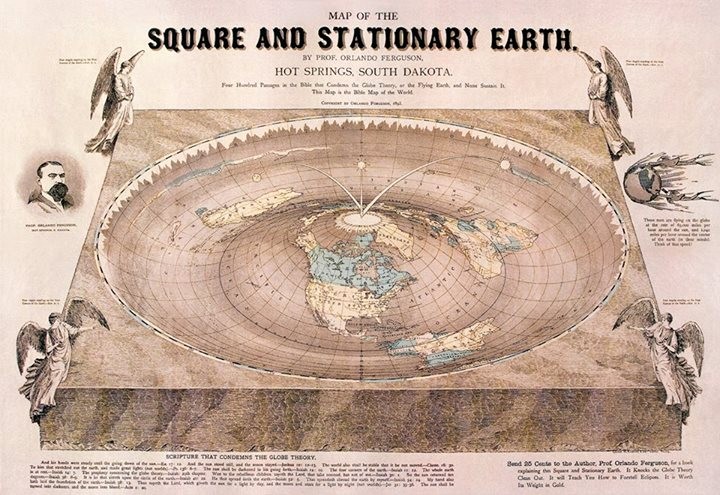
The above pic shows the circle of the earth as having both convexity and concavity to it which is obviously rather odd. It also does not show the dome. So, here is a 3D rendering of the Biblically described model. Before the Flood, the waters below (outside the dome) would have been raised up to cover most – if not all – of the dome. If true, obviously, the sides of the container would have to be higher. Also, if true, this would have caused an increase of pressure inside the dome and may account for the hyperbaric conditions many scholars describe as existing prior to the Flood.

When we get to the Book of Enoch’s take on this, you will see the earth and its boundary described in much greater detail. In the meantime, consider also what the Psalmist said:
Psalm 104:
- Bless YHWH, O my soul. O Lord my God, Thou art very great; Thou art clothed with honour and majesty.
- Who coverest thyself with light as with a garment: Who stretchest out the heavens like a curtain:
- Who layeth the beams of His chambers in the waters: Who maketh the clouds His chariot: Who walketh upon the wings of the wind:
- Who maketh his angels spirits; his ministers a flaming fire:
- Who laid the foundations of the earth, that it should not be removed for ever.
- Thou coveredst it with the deep as with a garment: the waters stood above the mountains.
- At Thy rebuke they fled; at the voice of Thy thunder they hasted away.
- They go up by the mountains; they go down by the valleys unto the place which Thou hast founded for them.
- Thou hast set a bound that they may not pass over; that they turn not again to cover the earth.
Which image better fits what we are reading thus far concerning our circular earth with a boundary around it?
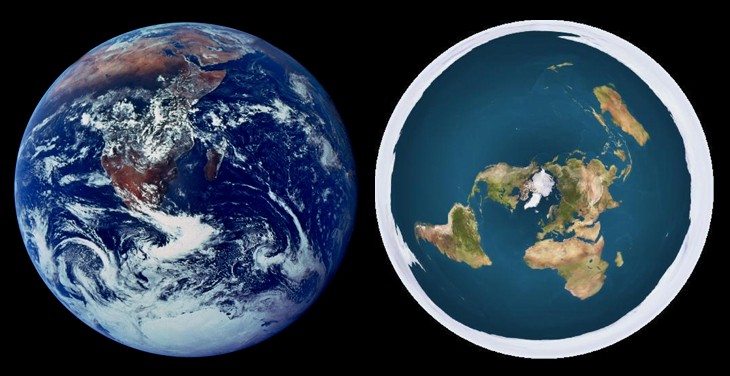
We’ve been taught that the Earth is spinning, with its surface at the equator moving at a speed of roughly 1,000 miles per hour. And we’re told the Earth is zooming around the sun at about 66,600 miles per hour. In addition, our solar system–Earth and all–whirls around the center of our galaxy at some 490,000 miles per hour… but there are a number of Scriptures describing the Earth as being fixed and not moving. This particular passage from Job really catches ones’ attention:
Job 38:
- Then the Lord answered Job out of the whirlwind, and said,
- Who is this that darkeneth counsel by words without knowledge?
- Gird up now thy loins like a man; for I will demand of thee, and answer thou me.
- Where wast thou when I laid the foundations of the earth? declare, if thou hast understanding.
- Who hath laid the measures thereof, if thou knowest? or who hath stretched the line upon it?
- Whereupon are the foundations thereof fastened? or who laid the corner stone thereof;
Again, Job is believed by many to have been the first book of Scripture written. In it, we see in verse 1 that YHWH Himself is speaking. This is the Creator talking here! He speaks of “laying a foundation” with a “corner stone” that is “fastened” in place. If ever there was a Flat-ish Earther, anti-globalist Scripture, this one is it. How do you twist and distort that Scripture to fit a rotating globe, freely floating in space? Where is the “fastened foundation” with a “corner stone” in that model? Using the principle established in the Law of First Mention, we see there are a number of other authors who carry this theme forward:
1 Samuel 2:8 He raises up the poor from the dust; he lifts the needy from the ash heap, to make them sit with princes and inherit a seat of honor. For the pillars of the earth are the Lord’s, and on them he has set the world.
1 Chronicles 16:30 Fear before him, all the earth: the world also shall be stable, that it be not moved.
Psalm 93:1 The Lord reigneth, he is clothed with majesty; the Lord is clothed with strength, wherewith he hath girded himself: the world also is stablished, that it cannot be moved.
Psalm 96:
9 O worship the Lord in the beauty of holiness: fear before him, all the earth.
10 Say among the heathen that the Lord reigneth: the world also shall be established that it shall not be moved: he shall judge the people righteously.
11 Let the heavens rejoice, and let the earth be glad; let the sea roar, and the fulness thereof.
Psalm 104:5 Who laid the foundations of the earth, that it should not be removed for ever.
Looking at the various English translations of Psalm 104:5, it really doesn’t look like any of them are describing a rotating ball spinning around at 1,000 mph, while whisking around in some kind of an orbit at 66,600 mph. Rather, we have a verbal depiction of something totally stationary, established on a firm foundation…

Here are two of the above verses taken from the Septuagint (the others are pretty much the same as the KJV):
1 Chronicles 16:30 Let the whole earth fear before Him; let the earth be established, and not be moved.
Psalm 93:1 YHWH reigns; He has clothed himself with honour: YHWH has clothed and girded Himself with strength; for He has established the world, which shall not be moved.
And then there is this one:
Zechariah 1:11 And they answered the angel of YHWH that stood among the myrtle trees, and said, We have walked to and fro through the earth, and, behold, all the earth sits quietly, and is at rest.
Some try and say, these verses just mean the earth is made the way God wants it and it’s placed where He wants it, not to be moved and (as in the case of Zechariah 1:11) things are in a “peaceful state” of being. OK. That may be one way to read these verses (which requires a globalist preconceived notion). But what if we just accept what it says, literally at face value? Especially considering Psalm 104:5 which clearly says the earth has “foundations” that won’t be moved. How does that look on a floating, rotating globe? Where do you put the “foundations” in that scenario? With the KJV renderings of these verses, some may say there is a difference between “earth” and “world,” as in the word “world” means people or nations. OK. Fine. Let’s go with that. So then what are these verses saying? All of the people are going to be frozen solid so that they “shall not be moved” or what? Seems to me, it’s just saying that this thing we are standing on has been established on something and it’s not going to be moved. Again, tossing out all preconceived ideas of a spinning globe, just reading the text by itself, no one would ever think anything different from what it says.
Plus, we use the word “world” as a synonym for “earth” all the time. As an example, one could say, “As a former missionary, for 6 years, I traveled the world, spreading the Gospel to people in over a dozen countries.” If one said that, you would clearly understand they were flying around the world – as in the earth – on mission trips.
What about seeming contradictions such as:
Job 9:6 Who shakes the earth from its place, and its pillars tremble.
Psalms 104:5 Thou didst set the earth on its foundations, so that it should never be shaken.
Isaiah 13:13 Therefore I will shake the heavens, and the earth shall remove out of her place, in the wrath of the LORD of hosts, and in the day of His fierce anger.
Isaiah 24:18 He who flees at the sound of the terror shall fall into the pit; and he who climbs out of the pit shall be caught in the snare. For the windows of heaven are opened, and the foundations of the earth tremble.
Those are just a few examples of this nature. There are others, which clearly show the earth being knocked around in various ways. There is a difference between YHWH being able to shake, rattle and roll the earth at His pleasure or in His anger and the earth being removed altogether from its pillared foundation, so there is no contradiction here. It appears that YHWH has set this place up to be permanent, and though He may knock it around from time to time, its still not going to leave its firmly established foundation. Yes, earthquakes and catastrophe are permissible, but utter destruction will never come. Take the Flood of Noah for instance. Clearly, the world was rocked:
Genesis 7:11 In the six hundredth year of Noah’s life, in the second month, the seventeenth day of the month, the same day were all the fountains of the great deep broken up, and the windows of heaven were opened.
Something got shaken up quite a bit, yet, we’re still here. The earth still stands, unmoved, on a sure foundation. Indeed, without a doubt, Scripture is telling us the earth is not constantly moving.
Let’s forget the globe vs flat/enclosed earth debate for the moment. Start breaking down the various arguments. Some may argue that the geocentric vs heliocentric models are apart from the globe vs flat/enclosed models – as in they are separate, unrelated arguments. However, they are much more connected than many may think. Because if we end up proving the Scriptures mean what they say concerning the earth not moving, then why not accept what it says concerning its circular shape and nature “under the dome” too? Scripture is clearly telling us the world/earth is circular and enclosed and not spherical and floating in an open system of planets and stars outside of the firmament. Amos 9:6 is also rather interesting, but its meaning gets completely lost in the KJV:
Amos 9:6 It is He that buildeth his stories in the heaven, and hath founded His troop in the earth; He that calleth for the waters of the sea, and poureth them out upon the face of the earth: YHWH is his name.
This use of the word “troop” here gives us the idea of “boots on the ground.” But that doesn’t appear to be what is being said there. Consider some of the other renderings of this verse:
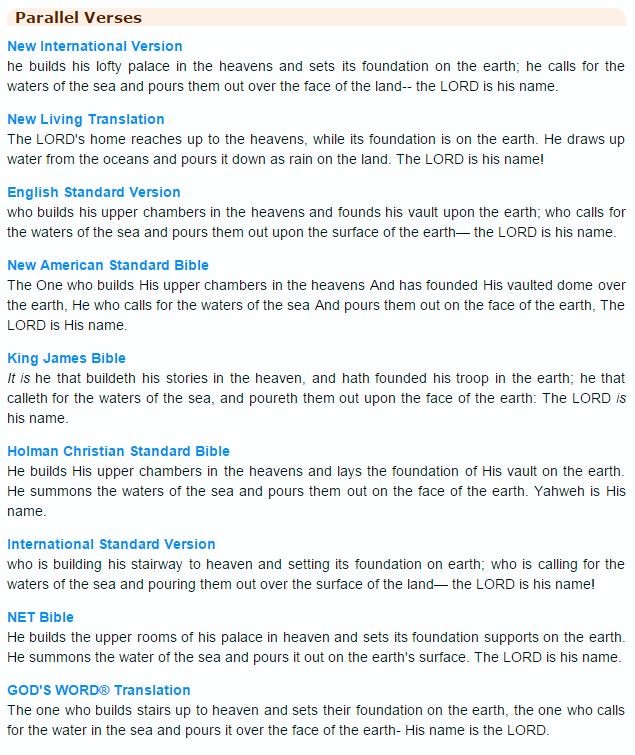
The NASB uses the words “vaulted dome” there. The Hebrew word in question is “aguddah,” which according to Brown-Driver-Briggs means:
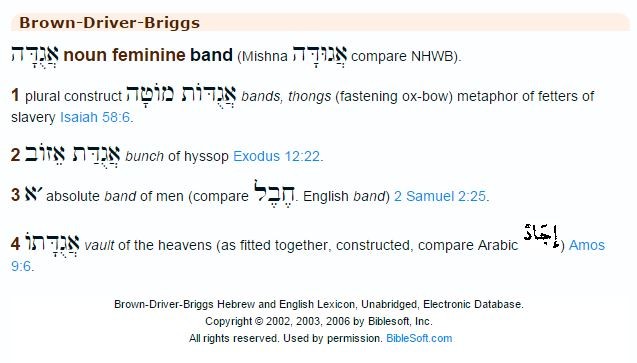
So, here again, we have the sense of a vaulted dome setting on the earth. This dome of Heaven is also described as circular:
Job 22:14 (HCSB) Clouds veil Him so that He cannot be seen, as He walks on the circle of the sky.
Job 22:14 (LXX) A cloud is His hiding-place, and He shall not be seen; and He passes through the circle of heaven.
This makes one think of those long-term exposure pictures we have all seen of the night sky:
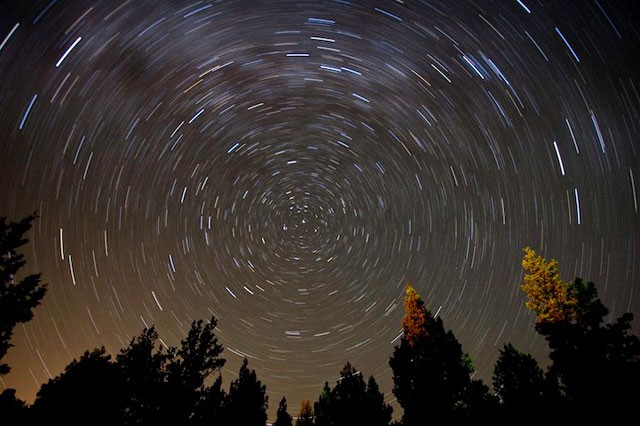

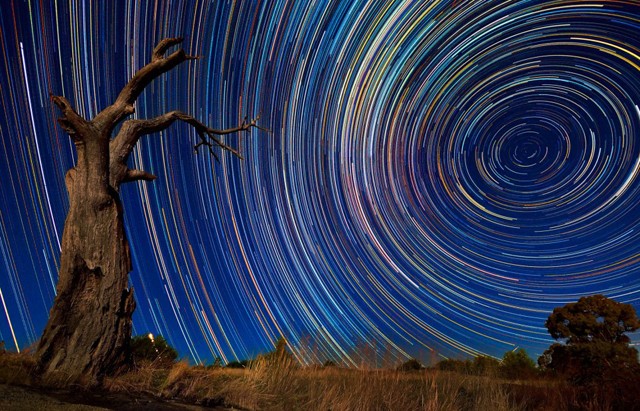
According to the Scriptures we’ve looked at so far, we have the Earth under the stretched out “curtain of heaven,” on a foundation that won’t be moved, set about with a boundary. This is painting an interesting picture, but again, it’s definitely not looking like a globe to me. And it also doesn’t look like the Earth is spinning either. Rather, we see the Scriptures painting a picture of a stationary, circular Earth under the circle of heaven. Could the above pics represent the “circle of heaven” in a literal sense? What if the pole star is the actual base of the “circle of heaven” upon which YHWHs’ throne sits? Then we have the whole issue of the so-called “corners” and “ends” of the Earth…
Job 28:24 For He looketh to the ends of the earth, and seeth under the whole heaven;
Job 37:3 He directeth it under the whole heaven, and His lightning unto the ends of the earth.
Job 38:13 That it might take hold of the ends of the earth, that the wicked might be shaken out of it?
Isaiah 11:12 And He shall set up an ensign for the nations, and shall assemble the outcasts of Israel, and gather together the dispersed of Judah from the four corners of the earth.
Isaiah 43:6 I’ll say to the north, ‘Give them up’! and to the south, ‘Don’t keep them back!’ Bring my sons from far away and my daughters from the ends of the earth—
Matthew 24:31 And he shall send his angels with a great sound of a trumpet, and they shall gather together his elect from the four winds, from one end of heaven to the other.
Revelation 7:1 And after these things I saw four angels standing on the four corners of the earth, holding the four winds of the earth, that the wind should not blow on the earth, nor on the sea, nor on any tree.
Revelation 20:8 He will go out to deceive Gog and Magog, the nations at the four corners of the earth, and gather them for war. They are as numerous as the sands of the seashore.
Many Christian apologists want to convince us this is talking about the four cardinal points. But if we accept that the authors of Scripture were directly inspired by the Holy Spirit of the Creator Himself, don’t you think they would have used better terms to describe a spinning globe orbiting the sun if that were indeed the case? If the Bible really is written in 5th Grade reading level English as so many have tried to teach us our whole lives, then, a simple reading of the Scriptures absolutely does not paint a picture of a globe! No kid – unhindered by the interpretation and indoctrination of a “scientist,” an “astronaut,” “scholar” or “theologian” – would ever get a spinning globe out of any of the above. Rather, again, Scripture appears to be describing something that looks a lot more like this:
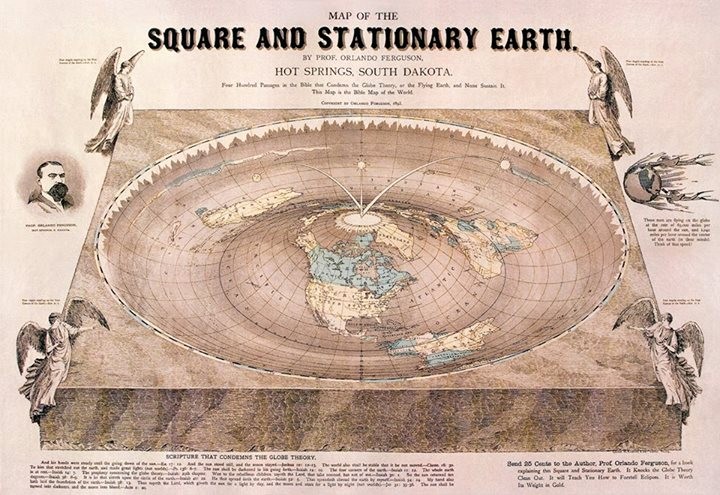
And then what are we supposed to do with these Scriptures…
Joshua 10:13 And the sun stood still, and the moon stayed, until the people had avenged themselves upon their enemies. Is not this written in the book of Jasher? So the sun stood still in the midst of heaven, and hasted not to go down about a whole day.
Habakkuk 3:11 The sun and moon stood still in their habitation: at the light of thine arrows they went, and at the shining of thy glittering spear.
Isaiah 38:8 Behold, I will bring again the shadow of the degrees, which is gone down in the sun dial of Ahaz, ten degrees backward. So the sun returned ten degrees, by which degrees it was gone down.
Those three Scriptures alone argue more in favor of a stationary, fixed earth with a moving sun and moon inside the earth’s firmament than for the typical model we – including me – hold to concerning our globe going around the sun. Even more so when you consider the small sun and moon (which are described as being the same size in the Flat/Enclosed Earth model) are described as parking over specific cities:
Joshua 10:12 Then spake Joshua to YHWH in the day when YHWH delivered up the Amorites before the children of Israel, and He said in the sight of Israel, Sun, stand thou still upon Gibeon; and thou, Moon, in the valley of Ajalon.
Ultimately, the question of the Bible’s validity is raised when looking at the mechanics of the Joshua, Habakkuk and Isaiah stories from the “scientific” perspective. Because the only way the sun and moon could stand still and/or move BACKWARD across the sky in our standard model would be for the earth to stop or suddenly begin to rotate the other way, then correct itself and then start back up again in order to get everything back to normal.
Using the scene from the first Superman movie as an example, the question of what would happen if the earth stopped rotating is addressed by the “How Stuff Works” website:
“Earth’s magnetic field might go away, too. While we’re not entirely sure how that magnetic field is generated, one leading theory states that it’s the result of Earth’s inner core rotating slightly faster than outer core (yep, two different rotations on one planet). If both of them stop, the mechanism behind Earth’s magnetic field may as well, leaving us exposed to potential harmful solar winds”. OMG!!!
Or how about this one from NASA:
“If the Earth stopped spinning suddenly, the atmosphere would still be in motion with the Earth’s original 1100 mile per hour rotation speed at the equator. All of the land masses would be scoured clean of anything not attached to bedrock. This means rocks, topsoil, trees, buildings, your pet dog, and so on, would be swept away into the atmosphere.” ARGHHH!!!
So, if we are to claim we believe the Bible is true and we can take it literally, we have a big problem concerning the stories that describe the sun and moon standing still, and even going backward. These are questions worthy of answering from a Biblical world view. And typical “apologetics” responses such as the ones given here, don’t really cut it: http://creation.mobi/joshuas-long-day Surely, we can do better than that! Of course, saying, “Well, God can do anything. He created the Universe, so surely He could suspend all of the laws of nature and physics to accommodate these miracles” is a nice Kindergarten answer. But such an answer will never satisfy a skeptic with an analytical, scientific mind. They will instead write our Bible off as a book of fantasy. Science triumphs over fantasy. Why believe a book that is so demonstrably false? See the problems we run into?
In an enclosed, flat-ish, stationary model however, those problems are easily solved. The same with Scriptures like these:
Daniel 4:
10 Thus were the visions of mine head in my bed; I saw, and behold a tree in the midst of the earth, and the height thereof was great.
11 The tree grew, and was strong, and the height thereof reached unto heaven, and the sight thereof to the end of all the earth:
Could these verses be speaking of the former splendor of massive trees that left us petrified stumps like Devils’ Tower in Wyoming?;
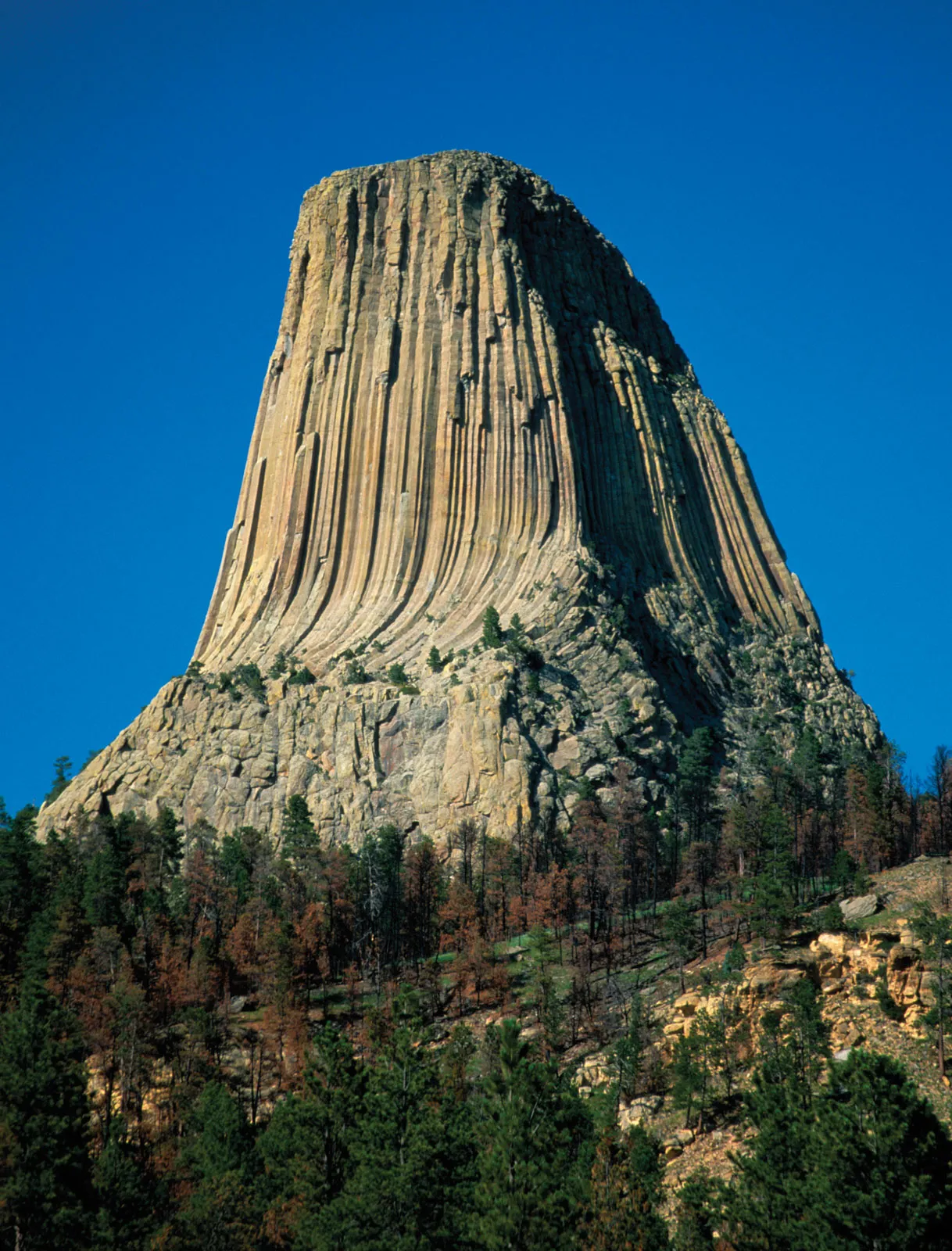
It’s a known fact that the higher we go the less particulate matter is in the air which allows us to see much farther horizontally. The question is, what mountain/s are being spoken of in verses like this;
Matthew 4:
8 Again, the devil taketh him up into an exceeding high mountain, and sheweth him all the kingdoms of the world, and the glory of them;
9 And saith unto him, All these things will I give thee, if thou wilt fall down and worship me.
Revelation 1:7 Behold, he cometh with clouds; and every eye shall see him, and they also which pierced him: and all kindreds of the earth shall wail because of him. Even so, Amen.
One can hear the arguments already. Daniel is having a dream. In the temptation of Christ, Satan could have shown Jesus a “movie” of sorts, or maybe it was just all of the “local kingdoms” viewable from that particular mountain. In Revelation, maybe Jesus has booked a round-the-world tour before touching down (despite the fact that Scripture seems to be saying He’s booked a direct flight, down from the clouds to the Mount of Olives). OK. But what if… we just believe what everyone else has been telling us in the Scriptures? If the world is flat-ish, each of the above examples are totally doable. We don’t have to make excuses, we just have to believe it.
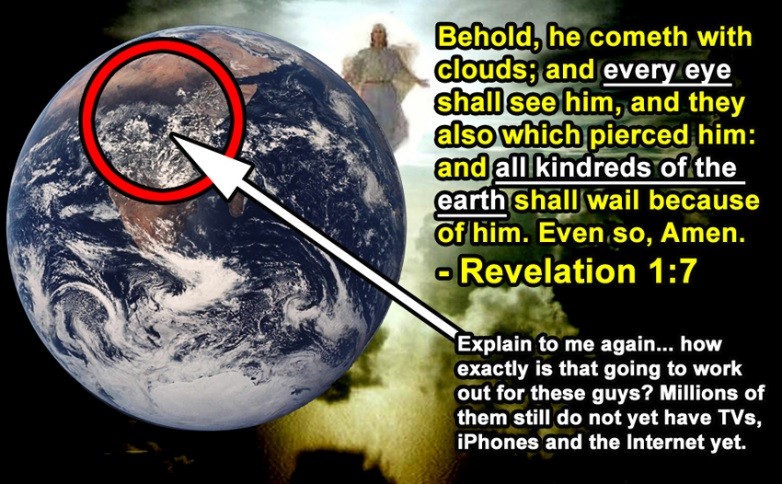
Then, of course we also have to deal with Scriptures that describe the stars falling from Heaven and/or ceasing to give their light, such as in these Scriptures:
Isaiah 13:9 Behold, the day of YHWH cometh, cruel both with wrath and fierce anger, to lay the land desolate, and He shall destroy the sinners thereof out of it.
10 For the stars of heaven and the constellations thereof shall not give their light: the sun shall be darkened in His going forth, and the moon shall not cause her light to shine.
What? The stars and constellations are all going to “wink out” and no longer give their light? But what about the alleged planets going around those stars? Of course, we can try and rationalize this away and say that we just won’t be able to see them because the sky on Earth is going to be cloudy or offer up some other lame, eisegetical explanation, but that’s not what the text says.
We must also consider the fact that Genesis as well as the book of Enoch both tell us that the moon is a (female) “lessor light” that is self illuminating. Nothing in the ancient texts even hint at her as being a reflector of the sun. Even science confirms the fact that her light is quite different from that of her fiery, male counterpart. Isaiah also confirms this idea by stating that the moon “shall not cause her light to shine.” Later in the text, Isaiah then goes on to describe the heavens rolling up like a scroll.
Isaiah 34:4 And all the host of heaven shall be dissolved, and the heavens shall be rolled together as a scroll: and all their host shall fall down, as the leaf falleth off from the vine, and as a falling fig from the fig tree.
Wait. What? The Universe is going to roll up like a scroll? Its “hosts” (stars/angels) are going to fall down… presumably on us?? How are we to imagine the cosmos that Carl Sagan and Stephen Hawkins want us to believe in doing this?
Furthermore, are we to accept the notion that the literal fate of the allegedly ever expanding Universe, as taught to us in school, literally hinges on the sin and subsequent judgement of humans on Earth? Are the worlds allegedly orbiting countless suns in billions of galaxies all going to be judged and burned up because of us? Is that really fair? Yet, this is exactly what we are literally forced to accept if we are to believe the Holy Spirit inspired words of prophets like Isaiah or apostles like Peter and John…
2 Peter 3:10 But the day of YHWH will come as a thief in the night; in the which the heavens shall pass away with a great noise, and the elements shall melt with fervent heat, the earth also and the works that are therein shall be burned up.
Revelation 6:14 And the heaven departed as a scroll when it is rolled together; and every mountain and island were moved out of their places.
By the way, we must also note that Isaiah’s prophecy concerning the stars falling finds a second witness in the words of Yeshua Himself!
Matthew 24:
24 For there shall arise false Christs, and false prophets, and shall shew great signs and wonders; insomuch that, if it were possible, they shall deceive the very elect.
25 Behold, I have told you before.
26 Wherefore if they shall say unto you, Behold, he is in the desert; go not forth: behold, he is in the secret chambers; believe it not.
27 For as the lightning cometh out of the east, and shineth even unto the west; so shall also the coming of the Son of man be.
28 For wheresoever the carcase is, there will the eagles be gathered together.
29 Immediately after the tribulation of those days shall the sun be darkened, and the moon shall not give her light, and the stars shall fall from heaven, and the powers of the heavens shall be shaken:
30 And then shall appear the sign of the Son of man in heaven: and then shall all the tribes of the earth mourn, and they shall see the Son of man coming in the clouds of heaven with power and great glory.
31 And he shall send his angels with a great sound of a trumpet, and they shall gather together his elect from the four winds, from one end of heaven to the other.
This is an extraordinary passage of Scripture! First, we are told that we will essentially be bedazzled by “signs and wonders” such that even “the very elect” could be deceived by them. Then, we are told what not to look for and what we should look for in the coming return of our Savior. Immediately after the tribulation, we discover that the sun is going to be darkened and the moon will no longer give (not reflect) her light, and the stars will literally fall from Heaven.
Again, we find another witness concerning the stars falling, by our Savior as given to the Apostle John:
Revelation 6:13 And the stars of heaven fell unto the earth, even as a fig tree casteth her untimely figs, when she is shaken of a mighty wind.
That’s what was revealed to us by God from two different witnesses over hundreds of years. So, if we say we take the Bible literally, we’ll have a big problem with these Scriptures. Then again, what right do we have to not take them literally? In other words, it is only our preconceived notions of stars such as Acturus, Vega, Pollux, Aldebaran, Betelgeuse and Sirius as essentially being distant suns with planets going around them that prevent us from taking these Scriptures literally. I mean, it would be a very bad day if stars are what Carl Sagan and other monkey-man scientists would have us to believe they are come falling down to earth like figs! But what if the stars really are intelligent beings? We see a number of references to angels as stars. Take these for instance:
Job 38:4 Where wast thou when I laid the foundations of the earth? declare, if thou hast understanding.
5 Who hath laid the measures thereof, if thou knowest? or who hath stretched the line upon it? 6 Whereupon are the foundations thereof fastened? or who laid the corner stone thereof; 7 When the morning stars sang together, and all the sons of God (Jinn) shouted for joy?
Singing stars during the Creation account? Note also that Job 38:7 quite literally obliterates the bogus “Sethite Theory” concerning Genesis 6:4. The sons of Seth were not there at the start of Creation. Sorry. Neither does the text of Genesis 6 make any mention whatsoever of the sons of Seth and the daughters of Cain. That’s bogus eisegetical theology at its best. No. The “sons of God” of Job 38:7 are the same as the “sons of God” in Genesis 6:4. They are “shedim” or “jinn” who were here before humans! But we digress, back to angels . . .
The Apostle John makes note of an angel as a star too…
Revelation 9:1 And the fifth angel sounded, and I saw a star fall from heaven unto the earth: and to him was given the key of the bottomless pit.
People even began to worship the stars as god-like, sentient beings:
2 Kings 21:5 And he built altars for all the host of heaven in the two courts of the house of YHWH.
2 Kings 23:5 (ISV) The king unseated the idolatrous priests whom the kings of Judah had appointed to burn incense in the high places throughout the cities of Judah and in the environs surrounding Jerusalem, including those who had been burning incense to Baal, to the sun, to the moon, to the constellations, and to every star in the heavens.
Note: I chose the ISV for 2 Kings 23:5 because I believe the KJV is in error in its use of the word “planets” for “mazzaloth,” which is the Hebrew version of what we call the Zodiac, or as the ISV renders it, “the constellations.”
Acts 7:43 Yea, ye took up the tabernacle of Moloch, and the star of your god Remphan, figures which ye made to worship them: and I will carry you away beyond Babylon.
Biblically speaking, the “hosts of heaven” are usually associated with the “armies of heaven” – or in other words the angels. But the “hosts of heaven” is also frequently used as a reference to the stars. Could there be a reason for this? I think so. Note also: IF this proves to be true, then we must re-evaluate our thinking concerning this Scripture too:
Revelation 19:11-13
And I saw heaven opened, and behold a white horse; and he that sat upon him was called Faithful and True, and in righteousness he doth judge and make war.
His eyes were as a flame of fire, and on his head were many crowns; and he had a name written, that no man knew, but he himself.
And he was clothed with a vesture dipped in blood: and his name is called The Word of God. 14 And the armies which were in heaven followed him upon white horses, clothed in fine linen, white and clean.
Again, all through the Scriptures, we see references to the armies of Heaven as “the hosts of heaven” and as YHWH being the “Lord of hosts” and such. Nowhere do we ever see a “bride” depicted as a soldier. Newly wedded women especially do NOT go to war. So it can not be the “Christians” (i.e. the “bride of Christ”) who were supposedly Raptured out earlier that are coming back with Him. Could it then literally be the “hosts of heaven” – the billions of stars we see up there in the dome – that are coming with Him?
Getting back to the nature of our world and its place in the cosmos, there are a LOT more Scriptures we could look at regarding the above topics. In fact, the more you search the Bible for your answers, you’ll keep running into descriptions of the earth stating:
- It is fixed and not moving (spinning, orbiting, etc.)
- It is circular and has edges/corners/pillars/foundations, etc.
- The #4 comes up a lot in reference to 4 corners, 4 winds, etc. – the 4 corners indicating a circle carved into a square
- It is hedged about with a boundary that connects with Heaven
- There is a metallic canopy of sorts stretched out like a “tent” over it, within which the (sentient?) stars, sun and moon are placed to move about above the stationary earth.
Whether or not we want to accept this will depend on our willingness to admit the level of cognitive dissonance we still want to maintain. Things get even worse if we accept the Book of Enoch as having any measure of credibility, because that book knocks a home run out of the park for the Flat-ish Earthers. And many like to point to the book of Job as a source for supporting the model of the Earth allegedly floating in the nothingness of space.
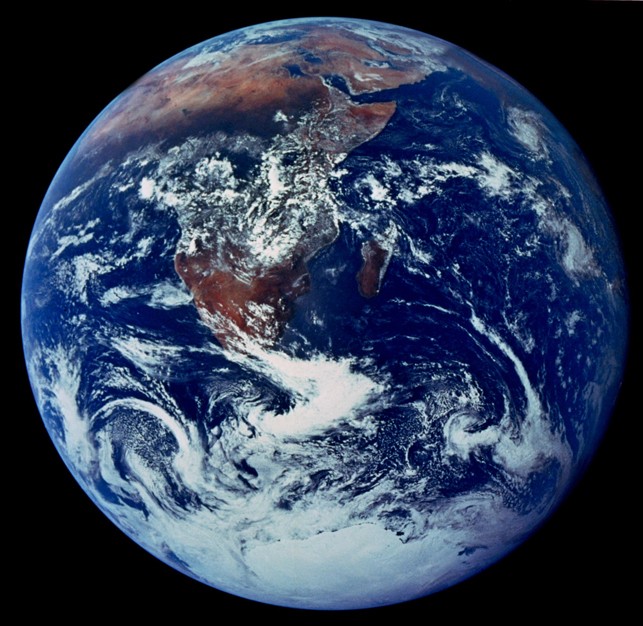
To promote this idea, they use one verse cherry-picked from Scripture:
Job 26:7 He stretcheth out the north over the empty place, and hangeth the earth upon nothing.
They’ll say, “See! Job is saying that the earth is hanging/suspended/floating in nothingness. This proves the earth is floating in space.” But is this verse really saying that?
The word used for “nothing” is “belimah” and it likewise finds only this one singular reference in the whole of Scripture.
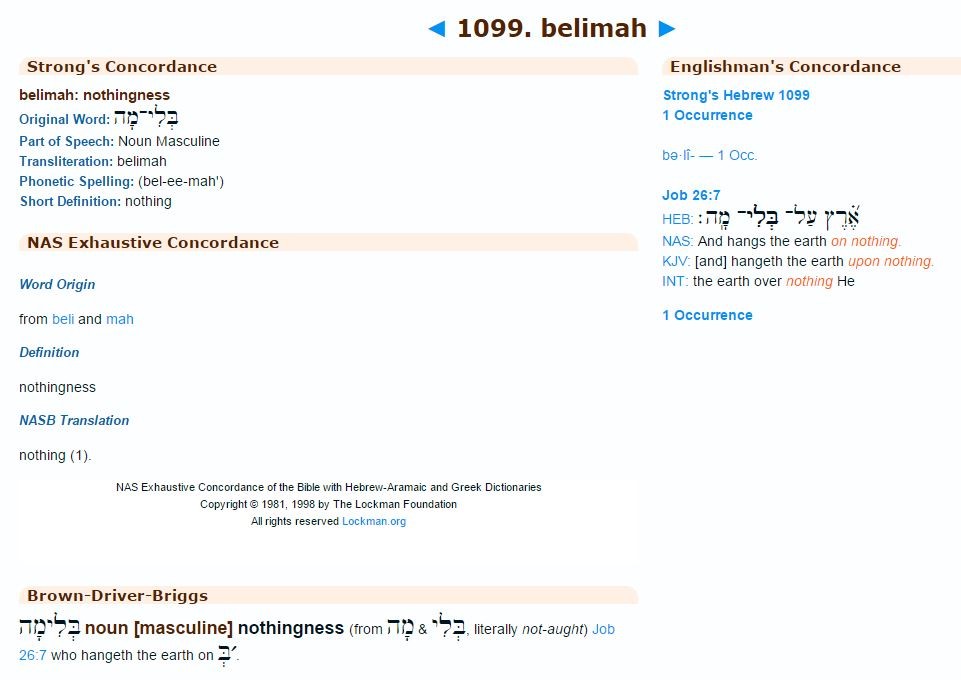
So, we can’t even get a second textual witness for this idea. Yet, Scripture says (over and over again) that we need two to three witnesses to establish truth (for instance: 2 Corinthians 13:1). So, where are the confirming witnesses in Scripture for the notion that the Earth is suspended in nothingness? There are none. But what if that’s not what Job was saying anyway?
If one were to say, “I am in want for nothing” you would understand this to mean that they do not want anything. In other words, they lack no thing. Even the dictionary confirms this:

Likewise, if one were to say, “There is nothing you can do for me.” you would understand that there is not anything you could do. So, could it be that when Job spoke in chapter 26 verse 7, he is really saying “The earth is not hung on anything”? In other words, Job knew that the world is not “hung on anything” but rather it is set on pillars! Indeed, just a few verses later, he recognizes that Heaven is also set on pillars!
Job 26:11 The pillars of heaven tremble and are astonished at His reproof.
In his cosmological worldview, the heavens were attached to the earth, which was itself set on pillars:
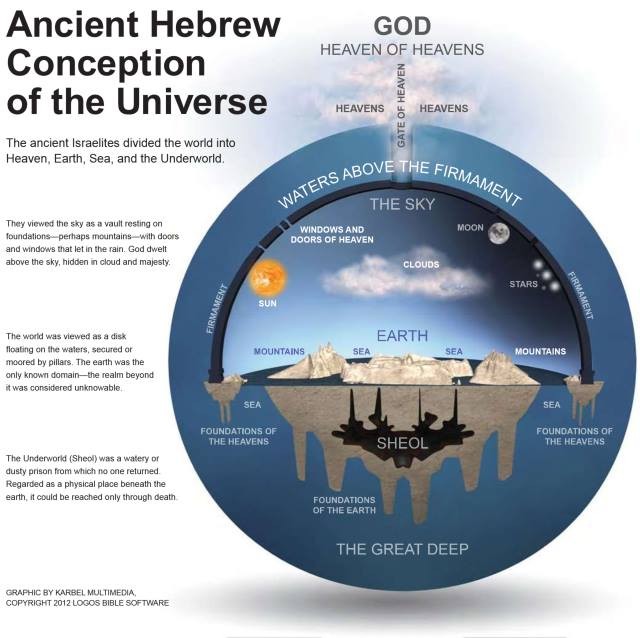
So, if Job had the above understanding, he certainly could not have been saying that the Earth is suspended (as a ball) in empty space. Furthermore, if we assume the notion that he had a contrary view to the above depicted cosmology, we end up having Job contradicting himself. After all, he was also the one speaking earlier in Job chapter 9, where we find him saying…
Job 9:6 Which shaketh the earth out of her place, and the pillars thereof tremble.
In confirmation of this, in Job 38, it is YHWH Who is speaking there (as a very powerful second Witness) and He likewise conveys the idea that the Earth is set on a “foundation” – rather than hanging from anything. So, in other words, He confirms that the Earth is hung on no-thing, but rather it is set on something.
Job 38:
- Then YHWH answered Job out of the whirlwind, and said,
- Who is this that darkeneth counsel by words without knowledge?
- Gird up now thy loins like a man; for I will demand of thee, and answer thou Me.
- Where wast thou when I laid the foundations of the earth? declare, if thou hast understanding.
- Who hath laid the measures thereof, if thou knowest? or who hath stretched the line upon it?
- Whereupon are the foundations thereof fastened? or who laid the corner stone thereof;
- When the morning stars sang together, and all the sons of God (Jinn) shouted for joy?
Later in Holy Spirit inspired Scripture, we get more details concerning this foundation…
Samuel 2:8 He raiseth up the poor out of the dust, and lifteth up the beggar from the dunghill, to set them among princes, and to make them inherit the throne of glory: for the pillars of the earth are YHWHs’, and He hath set the world upon them.
Samuel 22:16 And the channels of the sea appeared, the foundations of the world were discovered, at the rebuking of YHWH, at the blast of the breath of his nostrils.
1 Chronicles 16:30 Fear before Him, all the earth: the world also shall be stable, that it be not moved.
Psalm 18:15 Then the channels of waters were seen, and the foundations of the world were discovered at thy rebuke, O Lord, at the blast of the breath of Thy nostrils.
Psalm 75:3 The earth and all the inhabitants thereof are dissolved: I bear up the pillars of it. Selah.
Psalm 93:1 YHWH reigneth; He is clothed with majesty; YHWH is clothed with strength, wherewith He hath girded Himself: the world also is stablished, that it cannot be moved.
Psalm 96:
9 O worship YHWH in the beauty of holiness: fear before him, all the earth.
10 Say among the heathen that YHWH reigneth: the world also shall be established that it shall not be moved: He shall judge the people righteously.
11 Let the heavens rejoice, and let the earth be glad; let the sea roar, and the fullness thereof.
Psalm 102:25 Of old hast Thou laid the foundation of the earth: and the heavens are the work of Thy Hands.
Psalm 104:
5 Who laid the foundations of the earth, that it should not be removed for ever.
6 Thou coveredst it with the deep as with a garment: the waters stood above the mountains.
7 At thy rebuke they fled; at the voice of thy thunder they hasted away.
8 They go up by the mountains; they go down by the valleys unto the place which thou hast founded for them.
9 Thou hast set a bound that they may not pass over; that they turn not again to cover the earth.
Jonah 2:6 I went down to the bottoms of the mountains; the earth with her bars was about me for ever: yet hast thou brought up my life from corruption, O Lord my God.
The last one from Jonah uses a different word. It uses the Hebrew word “beriach,” which while not being a pillar, still conveys the same basic imagery of a shaft or a pole:
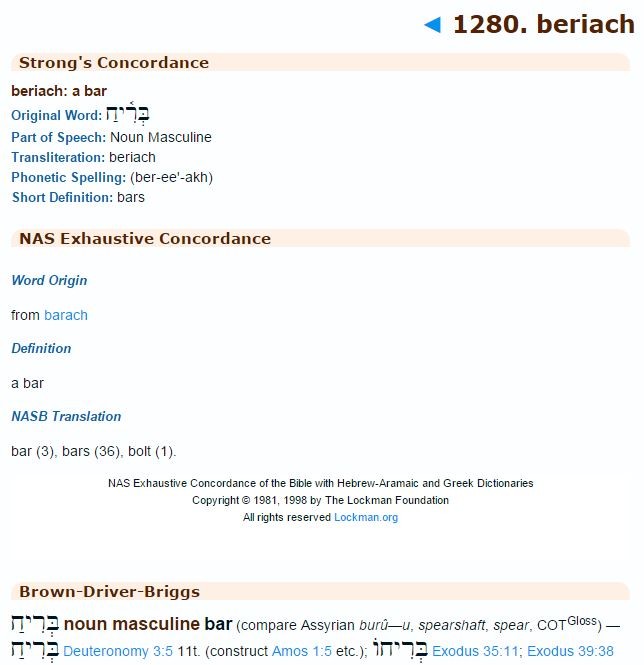
The word for “pillars” in Hebrew is “ammud”:
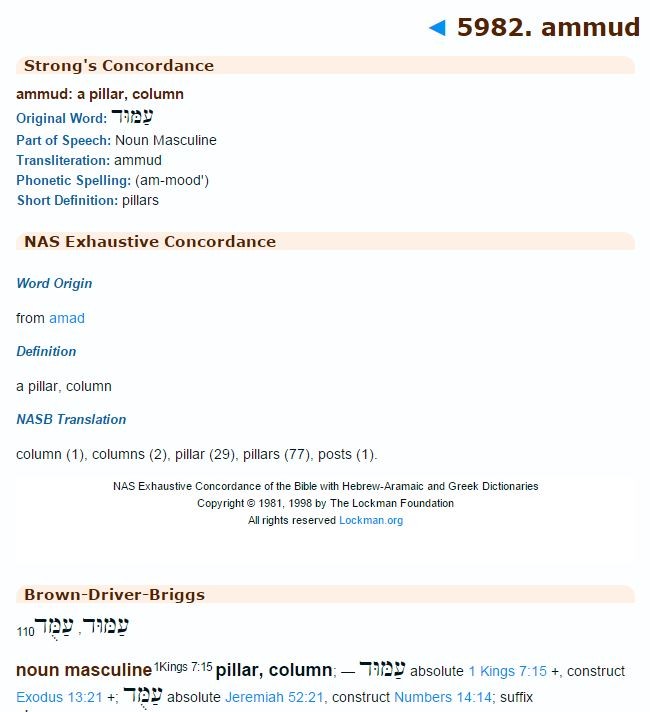
These “ammud” pillars are the foundation upon which the earth is set. Speaking of the word “foundation,” that comes from the Hebrew word, “yasad”:
So, how can a the earth be “hanging from nothing” yet still be set on a firmly placed foundation – with a “corner stone” no less (Job 38:6)? That makes no sense.
Perhaps one of the most easily understood usages of this concept of pillars as a foundation is given to us in the story of Samson…
Judges 16:
23 Then the lords of the Philistines gathered them together for to offer a great sacrifice unto Dagon their god, and to rejoice: for they said, Our god hath delivered Samson our enemy into our hand.
24 And when the people saw him, they praised their god: for they said, Our god hath delivered into our hands our enemy, and the destroyer of our country, which slew many of us.
25 And it came to pass, when their hearts were merry, that they said, Call for Samson, that he may make us sport. And they called for Samson out of the prison house; and he made them sport: and they set him between the pillars.
26 And Samson said unto the lad that held him by the hand, Suffer me that I may feel the pillars whereupon the house standeth, that I may lean upon them.
27 Now the house was full of men and women; and all the lords of the Philistines were there; and there were upon the roof about three thousand men and women, that beheld while Samson made sport.
28 And Samson called unto YHWH, and said, O Lord GOD, remember me, I pray Thee, and strengthen me, I pray Thee, only this once, O God, that I may be at once avenged of the Philistines for my two eyes.
29 And Samson took hold of the two middle pillars upon which the house stood, and on which it was borne up, of the one with his right hand, and of the other with his left.
30 And Samson said, Let me die with the Philistines. And he bowed himself with all his might; and the house fell upon the lords, and upon all the people that were therein. So the dead which he slew at his death were more than they which he slew in his life.
31 Then his brethren and all the house of his father came down, and took him, and brought him up, and buried him between Zorah and Eshtaol in the buryingplace of Manoah his father. And he judged Israel twenty years.
We all remember the story. The house had a roof, set on pillars. Samson pushed aside the two main pillars and it all came down. The same word for pillars (ammud) is used here, conveying the same thing: Something set on a foundation pillars. This is how the ancient Hebrews understood the Earth – and indeed, this was also the view of the entire Ancient Near East.
Taking a more scholarly approach to the above issue concerning Job 26:7, Robert Schneider of the Berea College wrote an on-line article for The American Scientific Affiliation, also noting that the idea of the Earth floating in the nothingness of space was foreign to Job:
Job 26:7–Empty Space or Whatnot?
Yamauchi concludes his article with: “Note the remarkable concept given in Job 26:7.” Let us turn now to this other passage. Here is how the NRSV renders this verse:
He stretches out Zaphon over the void, and hangs the earth upon nothing.
Like the poetic oracles of the prophet who proclaimed the words of Isa 40:22, the Book of Job contains some of the most powerful and affecting verse in the Old Testament. And Job 26:7, a couplet with a subject-verb-object-preposition-object arrangement, exemplifies an important feature of Hebrew poetry, its parallel structure. Here is the verse in a consonantal transliteration, followed by Suder’s literal translation:
nth tzphn ‘l – thw tlh ‘rtz ‘l – bly-mh
[He] stretches Zaphon upon chaos, suspends the land upon what (not)?
Perhaps picking up on Yamauchi’s reference, Walter Kaiser writes in his article on belíimâ:
(from belíi and mâ: “not-aught”): “Found only in Job 26:7. The Lord ‘hangs the earth upon nothing’ (RSV), a remarkable vision of the earth being supported in space by the power of God.”40 It is this notion of the earth hanging in space that perhaps has encouraged creationists like Eastman and Morris to claim that this verse also refers to a spherical earth, although there is nothing that indicates plainly what shape of the earth the poet had in mind. I shall contend that interpreting Job 26:7 is a far from simple matter, and that its meaning is shrouded in mystery. The question is, can the mystery be penetrated?
The ambiguity that characterizes this poetic hymn verse begins in the first line with “Zaphon,” which some translators retain in English (NRSV, JPSV, Marvin Pope41) while most render it as “the north” (Geneva Bible followed by KJV and NKJV; NAB, NJB); the REB reads “the canopy of the skies” and the NIV reads “the northern skies.”42 The Hebrew sapôn is of uncertain etymology, but in the Canaanite tablets unearthed at Ugarit in 1927, Zaphon is described as the mountain of the ba’alim. It has been identified with Mt. Casius in northern Syria. Zaphon as mountain is found in other passages of the Old Testament: in the derision song of Isa. 14:4-20, Zaphon is identified with the mount of assembly of the gods in the north (v. 13); and in the praise psalm 48, Zion the mount of Yahweh is called (v. 2) “peak of
Zaphon.”43 Sapôn also came to mean “the north” as a compass point or geographical location.44 It was probably with this interpretation in mind that the LXX used the Greek word for “north,” boréan; and both the Old Latin and the Vulgate usedaquilonem, the Latin equivalent. Likewise, many English versions have used “the north.” Since heaven and earth are often coupled in creation hymns, some translators have interpreted sapôn here to mean “the heaven.”45 W. H. Schmidt opines that it is difficult to imagine a mountain being “stretched out,”46 and there are those passages in Isaiah in which God is said to “stretch out” the heavens (40:22b; 42:5; 44:24). Still, there is little consensus among translators as to its meaning.
In the next line, there is a remarkable image: God “hangs (or, suspends) the earth upon nothing.” What does “hang” mean in this context, and what meaning of “the earth” is to be understood? The Hebrew word tâlâh here means “hang” in the sense of “hang something on something,” e.g., upon a peg (cf. Isa. 44:23-24; Ezek. 15:3).47 The meaning of “earth” (‘erets) here seems somewhat ambiguous: it may refer to the earth as the other part of a bipartite creation,48 but it may refer also to the earth as “the land.” The combined words may remind one of Job 38:12-13, where God commands the dawn to “take hold of the skirts of the earth” (NRSV) and shake the wicked out of it.49 Does the poet by this metaphor suggest that the earth is to be imaged as a garment, not hanging down, perhaps, but spread out? No certain answer can be given, I think.
The crux of this remarkable couplet, however, lies in the words that end each line. In the first, God “stretches Zaphon over tohû,” and in the second he “hangs the earth upon belíimâ.” In the parallelism that characterizes Hebrew poetry, the same thing or concept is often repeated using a different word or phrase, so it may be that belíimâ in some way repeats or develops the notion intended by tohû. I shall review the various meanings of these terms, then examine how they have been rendered.
The first, tohû, harks back to the tohûwabohû of Gen. 1:1, where the earth, i.e., the other part of the creation besides the heavens, is described as “formless and empty.” HELOT refers specifically to Job 26:7 in giving “nothingness, empty space” as meanings. A. H. Konkel, citing the same verse, reads tohû as “nothingness, void, emptiness.”50 The word that concludes the second line is a hapax legomena composed of belíi and mâ.51 Mâ functions both as an interrogative and as an indefinite pronoun, meaning “What?” “How?” or “aught.”52 Belíi, meaning “not,” is a negative used primarily in poetry; rather than negating something it conveys the sense of “without something.”53 Kaiser renders belíima as “not aught.”54 But might mâ have an interrogative rather than an indefinite force here, as in Suder’s translation? Is the poet asking “what?”
If we put these two together, do we have a notion resembling tohûwabohû, something that is akin to “formless and empty”? Does belíimâ reinforce and make stronger the meaning of tohû, the author expressing more intensely the sense of nothingness and emptiness over and upon which God “stretches” and “hangs”? Such an interpretation, and the parallelism evident in this couplet, might, in turn, lead the reader to take “Zaphon” literally, referring not to the northern skies but to the mountain that rests upon the earth to the geographical north and which might be understood as an earthly dwelling place of God, so that the whole couplet refers to the earthly part of the creation hung and stretched out over the mysterious “not-anything.”
In 1560 and 1611, the heavens were understood to consist of a series of concentric spheres filled with the element aether; there was no such concept as “empty space,” at least not one acceptable to the great majority of the educated.
Kaiser remarks that while it would be improper to impose twentieth-century cosmological knowledge on this creation hymn, “it is nonetheless striking that 26:7 pictures the then-known world as suspended in space. In so doing, it anticipates (at the very least!) future scientific discovery.”55 Comments like this as well as renderings of tohû as “empty space” might give encouragement to creationist interpreters of this verse. Before assessing this translation, let us see what tradition offers.
The LXX translators appear to have understood these two words to be equivalent, for they rendered both by the Greek neuter form oudén, “nothing,” using in the first line the accusative singular oudén, in the second the genitive singular oudenós, both with the same preposition, epí, “upon” or “over,” which may express the concept of place with either grammatical case, and in particular with the accusative can convey the meaning of “extension over a place.”56 In the Old Latin versions, we find tohû rendered as nihilum, belíimâ asnihilum in aerem.57 In the Vulgate, Jerome, relying on the Hebrew, renders the first with the neuter accusative vacuum, the second with the neuter accusative nihilum.58 Both words are introduced by the same preposition, super, “above, over, upon.” The basic meaning of vacuum is “not containing or holding anything, empty.” Jerome evidently thought that it conveyed the meaning of tohû better than the nihilum of the Old Latin. The latter word has the basic meaning of “not anything, nothing,” thus to Jerome conveying the sense ofbelíimâ.59
The ancient translators seem to have attempted to render the Hebrew as literally as they could.
Twentieth-century translators offer a variety of readings. Belíimâ is rendered as “nothing” (NIV, NKJV, NRSV, Pope), “nothingness” (NJB), “nothing at all” (NAB), “the void” (REB), or “emptiness” (JPSV), all introduced by the prepositions “over” or “upon.” Tohû is variously translated as “the void” (NJB, NRSV, Pope), “chaos” (JPSV, REB), or “empty space” (NIV, NKJV, NAB).
I think the translation “empty space” is rather problematical. It is instructive to examine the difference between the readings of the KJV translators and their modern revisers. Instead of “empty space” (NKJV) the former, following verbatim the Geneva Bible, translatedtohû as “the empty place.” Here is the entire couplet:
He stretcheth out the North (KJV, north) over the empty place, and hangeth the earth upon nothing.
The difference is telling to anyone familiar with the world-picture that prevailed in the sixteenth and early seventeenth centuries. The Reformation translators still lived in an Aristotelian and Ptolemaic cosmos, whether or not any of them had become Copernicans. Aristotelian science dominated the universities. In 1560 and 1611, the heavens were understood to consist of a series of concentric spheres filled with the element aether; there was no such concept as “empty space,” at least not one acceptable to the great majority of the educated. While it had come under serious criticism by some Renaissance philosophers, Aristotle’s concept of Place (tópos) still held sway. For Aristotle, everything in the Cosmos exists in a Place, which he defined as the “containing vessel” of a thing. The inner sphere of the revolving heavens constitutes the containing vessel of the earth, and likewise, within the domain of the earth each thing’s place “must need be … the limiting surface of the body continent–the content being a material substance susceptible of movement by transference.” In his exposition of this difficult concept in the Physics, Aristotle goes on to argue specifically against the existence of the Void, a central component of Epicurean atomism.60
While the word “space” is attested in English as early as the fourteenth century, it is not used to convey the notion of physical or astronomical space, certainly not the absolute space of Newton or the relative space of Leibniz, before the middle of the seventeenth century.61 Because of its association with atheism, the concept of the Void also was not popular; atomism needed a “baptism” by theoretical physicist Pierre Gassendi in the 1650s to render it respectable enough to be incorporated into a world view acceptable to Christian thought.62 The Protestant translators in Switzerland and England would not have understood the concept implied in the “empty space” of their latter-day revisers.
The translation “empty space” invites a popular interpretation based on a modern cosmology, not on the cosmology of the ancient Hebrews, and it lends encouragement to readers, whether creationists or not, to see in this passage in Job an “anticipation” of a modern concept.
Yet, if these translators breathed an atmosphere that was Aristotelian and had the notion of Place as a part of their world view, they have turned it on its head. No place in Aristotle’s world is “empty,” but these translators have written “the empty place.” What did they mean by “place” here? Specifically, what did they mean by “the empty place”? Were they expressing what to them would seem a paradox? Or were they simply trying to make sense of tohû given its basic meaning and this context, perhaps guided by the ep’ oudénof the LXX, with the prepositional sense of “extension over a place”? What they could not have meant by it is the “empty space” of a modern scientific world-picture, and that is what makes this particular translation so problematical. I think it is a good example of how a sincere attempt to render an ancient and puzzling expression into a term comprehensible to a contemporary readership can lead to misunderstanding.63The translation “empty space” invites a popular interpretation based on a modern cosmology, not on the cosmology of the ancient Hebrews, and it lends encouragement to readers, whether creationists or not, to see in this passage in Job an “anticipation” of a modern concept. But, to go from an indefinite “emptiness” and “what-not” to “empty space” or “infinite space” (NJB comment) is too big a stretch, too expansive an interpretation. Better, I think, to leave its meaning a mystery, as it seems to have been to the translators who gave us “the empty place” of the 1560 and 1611 versions.
What, then, can we make of Job 26:7? While its sense is hardly plain, one notion it certainly does not convey, I would tell my students, is that of a spherical earth held by the force of gravity in space (Morris). The earth that hangs on nothing is also the earth that rests on “pillars,” which tremble when God shakes the earth (Job 9:6), or upon a “foundation” with bases and a cornerstone (Job 38:6). It is also the dry land that God separated from the waters of the encircling deep (Gen. 1:9-10; Job 26:10; Prov. 8:27), that the psalmists describe as “founded … upon the ocean, set … upon the nether-streams” (24:1-2, JPSV; cf. Exod. 20:4), the earth which God “stretched out … above the waters” (136:6 KJV). I see no value in trying to reconcile these many and varied metaphorical images with our own image of a spherical, rotating planet–aside from the fact that these ancients did not think of the earth as a planet. What Job 26:7, indeed the entire creation hymn of which it is a part, does convey, in all of its majesty and mystery, is the presence and power of the One who creates and sustains, and who holds all of the creation under his gaze. The response it calls for is awe, not scientific analysis.
– Robert Schneider, excerpt from “Does the Bible Teach a Spherical Earth
Source: http://www.asa3.org/ASA/PSCF/2001/PSCF9-01Schneider.html
Unfortunately, just like Dr. Michael Heiser and others, Mr. Schneider provides an excellent analysis of the text, showing precisely how the ancients viewed the cosmos, but then (as usual) he negates all of it – just as many others do – by saying that the Bible is “not a book of science” and therefore we should not judge it by that criteria. Oddly enough, many Creationists would argue that the Bible does accurately teach science in a number of ways, while at the same time, they will dismiss every reference to the nature of the earth, sun, moon and stars, which conflicts with what monkey-man science teaches. Rather, instead, they will try and manipulate the text (as in Job 26:7) to try and force it to, in effect, be the “science” they want it to convey. This seems quite hypocritical, and whether intentionally or unintentionally, they are being very dishonest with the text.
So, which is it? Is the Bible only about “theological messaging” and anywhere that it speaks of the nature of the earth, sun, moon and stars it is always speaking “poetically” and “allegorically”… or does the Creator of the Universe actually know how to accurately describe His Creation to His created beings, who were made in His likeness? In Schneider’s concluding remarks he writes,
The theological truths about creation which Scripture proclaims are not dependent upon the cosmological models in which they are set. In fact, the biblical writers offer believers a valuable lesson for interpreting the doctrine of creation: one can take whatever is the current cosmological model and use it to understand more deeply and clearly God’s relationship to the creation. That is what Second Isaiah, the author of Job, and the writer(s) of Genesis 1 did: they conveyed revelations about creation using the “standard model” of the cosmos they shared with their Semitic neighbors, while at the same time challenging and rejecting their theogonies and theologies. And we can do the same.
One simply cannot agree with this idea because A) the text was not written for their “Semitic neighbors” and B) the text was Divinely inspired by the Holy Spirit and the Creator would surely know how to accurately describe His own creation to His intended audience – a people who were to be “set apart” from the beliefs of their “Semitic neighbors. So, this really seems like a lame apologetic.
Face it folks: The Bible says what it says, and unfortunately, for Christians and Creationists alike, it does not say anything that would in any way support the idea of a spinning, heliocentric globe, suspended in the nothingness of space, inside a galaxy among billions of others in an ever expanding universe. And selecting Job 26:7 as a singular, cherry-picked reference simply cannot be used to contradict the rest of Scripture – which clearly describes the earth as fixed, stationary, circular and flat-ish, with edges, set on pillars, under a dome, within which the sun, moon and stars were placed on Day 4 of Creation.
ENOCH AND THE STILL FLAT-ISH EARTH
When it comes to the Book of Enoch, many want to dispute whether or not we should consider it canon, or even a valid source for deriving, confirming and/or elaborating on the canonized Biblical truths. Many commentaries have been written giving the various perceived pros can cons of doing so. But there’s really no need to consider it “Scripture.” However, to value it primarily because the authors of Scripture certainly did, even to the point of directly quoting from it, while under the inspiration of the Holy Spirit.
Concerning the seeming ambiguities of canonized Scripture as it pertains to the issues being addressed here in this essay, one may prefer the way Robert Schadewald handles the Book of Enoch in his online article:
Ambiguities in ancient documents can often be elucidated by consulting contemporary documents. The most important ancient document describing Hebrew cosmology is 1 Enoch (sometimes called the Ethiopic Book of Enoch), one of those long, disjointed, scissors and paste jobs beloved by ancient scribes. For a dozen or so centuries, European scholars knew 1 Enoch only from numerous passages preserved in the patristic literature. In 1773, the Scottish adventurer James Bruce found complete copies in Ethiopia.
Numerous manuscripts of 1 Enoch have since been found in Ethiopian monasteries. Turn of the century scholars concluded that parts of the book are pre-Maccabean, and most (perhaps all) of it was composed by 100 B.C. [Charles, 1913]. These conclusions were largely vindicated when numerous fragments of 1 Enoch were found among the so-called Dead Sea Scrolls at Qumran.
* * *
First Enoch is important for another reason. Unlike the canonical books of the Bible, which were never meant to teach science, sections of 1 Enoch were intended to describe the natural world. The narrator sometimes sounds like a 2nd century B.C. Carl Sagan explaining the heavens and earth to the admiring masses. The Enochian cosmology is precisely the flat-ish earth cosmology previously derived from the canonical books.
Excepts sourced from: https://www.lhup.edu/~dsimanek/febible.htm
Whether or not we consider the Book of Enoch to be Scripture is irrelevant. If you at least accept it as having any measure of credibility as a contemporary Biblical commentary, you’ll see this concept of a flat-ish/enclosed earth is described in even more detail by its writer/s, thus revealing how the ancient Hebrews viewed the heavens, earth, sun, moon and stars when thy both wrote and read the canonized texts. For Enoch to have been so well preserved in multiple copies in the Dead Sea Scrolls and for authors such as Jude and later “Church Fathers” to quote directly from it, this shows us the book was held in high regard, at least well into the first few centuries AD. We must therefore contend it is still worthy of taking notice of in our day as well. Especially, when you consider the opening words of the book:
1 Enoch 1:1 The words of the blessing of Enoch, wherewith he blessed the elect and righteous, who will be living in the day of tribulation, when all the wicked and godless are to be removed. 2. And he took up his parable and said–Enoch a righteous man, whose eyes were opened by God, saw the vision of the Holy One in the heavens, which the angels showed me, and from them I heard everything, and from them I understood as I saw, but not for this generation, but for a remote one which is for to come.
We are that remote, future generation, that was to come and live “in the day of tribulation.” As many know, when you get to about chapter 17 or so, you start finding some very interesting descriptions of heaven and earth, which sound a lot like the Flat-ish/Enclosed Earth model. We will now explore just a handful of them here.
Enoch’s view on the nature of the earth:
1 Enoch 18:1 I saw the treasuries of all the winds: I saw how He had furnished with them the whole creation and the firm foundations of the earth. 2. And I saw the corner-stone of the earth: I saw the four winds which bear [ the earth and ] the firmament of the heaven. 3. And I saw how the winds stretch out the vaults of heaven, and have their station between heaven and earth: these are the pillars of the heaven . 4. I saw the winds of heaven which turn and bring the circumference of the sun and all the stars to their setting. 5. I saw the winds on the earth carrying the clouds: I saw the paths of the angels. I saw at the end of the earth the firmament of the heaven above. And I proceeded and saw a place which burns day and night, where there are seven mountains of magnificent stones, three towards the east, and three towards the south. 7. And as for those towards the east, 〈 one 〉 was of coloured stone, and one of pearl, and one of jacinth, and those towards the south of red stone. 8. But the middle one reached to heaven like the throne of God, of alabaster, and the summit of the throne was of sapphire. 9. And I saw a flaming fire. And beyond these mountains 10. is a region the end of the great earth: there the heavens were completed. 11. And I saw a deep abyss, with columns of heavenly fire, and among them I saw columns of fire fall, which were beyond measure alike towards the height and towards the depth. 12. And beyond that abyss I saw a place which had no firmament of the heaven above, and no firmly founded earth beneath it: there was no water upon it, and no birds, but it was a waste and horrible place.
Is Job 26:7 (concerning the earth hanging on “nothing”) just a confirmation of what Enoch is saying here? Enoch described a place where there was nothing. Job describes the same:
Job 26:7 He stretcheth out the north over the empty place, and hangeth the earth upon nothing.
Enoch clearly describes the earth on a foundation (like all the other authors as seen above). But he also describes a place beyond the ends of the earth. A place of horrible nothingness. Whatever your view may be, it is clear, either one of these authors has borrowed from the other or they both were inspired by the same Source. Enoch again describes this place…
1 Enoch 21: 1. And I proceeded to where things were chaotic. 2. And I saw there something horrible: I saw neither a heaven above nor a firmly founded earth, but a place chaotic and horrible.
1 Enoch 23:1. From thence I went to another place to the west of the ends of the earth.
1 Enoch 33:1. And from thence I went to the ends of the earth and saw there great beasts, and each differed from the other; and (I saw) birds also differing in appearance and beauty and voice, the one differing from the other. 2. And to the east of those beasts I saw the ends of the earth whereon the heaven rests, and the portals of the heaven open. 3. And I saw how the stars of heaven come forth, and I counted the portals out of which they proceed, and wrote down all their outlets, of each individual star by itself, according to their number and their names, their courses and their positions, and their times and their months, as Uriel the holy angel who was with me showed me. 4. He showed all things to me and wrote them down for me: also their names he wrote for me, and their laws and their companies.
Enoch’s view on the nature of the sun, moon and stars:
1 Enoch 72:1 The book of the courses of the luminaries of the heaven, the relations of each, according to their classes, their dominion and their seasons, according to their names and places of origin, and according to their months, which Uriel, the holy angel, who was with me, who is their guide, showed me; and he showed me all their laws exactly as they are, and how it is with regard to all the years of the world and unto eternity, till the new creation is accomplished which dureth till eternity. 2. And this is the first law of the luminaries: the luminary the Sun has its rising in the eastern portals of the heaven, and its setting in the western portals of the heaven. 3. And I saw six portals in which the sun rises, and six portals in which the sun sets and the moon rises and sets in these portals, and the leaders of the stars and those whom they lead: six in the east and six in the west, and all following each other in accurately corresponding order: also many windows to the right and left of these portals. 4. And first there goes forth the great luminary, named the Sun, and his circumference is like the circumference of the heaven, and he is quite filled with illuminating and heating fire. 5. The chariot on which he ascends, the wind drives, and the sun goes down from the heaven and returns through the north in order to reach the east, and is so guided that he comes to the appropriate (lit. ‘that’) portal and shines in the face of the heaven. 6. In this way he rises in the first month in the great portal, which is the fourth those six portals in the cast. 7. And in that fourth portal from which the sun rises in the first month are twelve window-openings, from which proceed a flame when they are opened in their season. 8. When the sun rises in the heaven, he comes forth through that fourth portal thirty mornings in succession, and sets accurately in the fourth portal in the west of the heaven. 9. And during this period the day becomes daily longer and the night nightly shorter to the thirtieth morning. 10. On that day the day is longer than the night by a ninth part, and the day amounts exactly to ten parts and the night to eight parts. 11. And the sun rises from that fourth portal, and sets in the fourth and returns to the fifth portal of the east thirty mornings, and rises from it and sets in the fifth portal. 12. And then the day becomes longer by two parts and amounts to eleven parts, and the night becomes shorter and amounts to seven parts. 13. And it returns to the east and enters into the sixth portal, and rises and sets in the sixth portal one-and-thirty mornings on account of its sign. 14. On that day the day becomes longer than the night, and the day becomes double the night, and the day becomes twelve parts, and the night is shortened and becomes six parts. 15. And the sun mounts up to make the day shorter and the night longer, and the sun returns to the east and enters into the sixth portal, and rises from it and sets thirty mornings. 16. And when thirty mornings are accomplished, the day decreases by exactly one part, and becomes eleven parts, and the night seven. 17. And the sun goes forth from that sixth portal in the west, and goes to the east and rises in the fifth portal for thirty mornings, and sets in the west again in the fifth western portal. 18. On that day the day decreases by two parts, and amounts to ten parts and the night to eight parts. 19. And the sun goes forth from that fifth portal and sets in the fifth portal of the west, and rises in the fourth portal for one-andthirty mornings on account of its sign, and sets in the west. 20. On that day the day is equalized with the night, [and becomes of equal length], and the night amounts to nine parts and the day to nine parts. 21. And the sun rises from that portal and sets in the west, and returns to the east and rises thirty mornings in the third portal and sets in the west in the third portal. 22. And on that day the night becomes longer than the day, and night becomes longer than night, and day shorter than day till the thirtieth morning, and the night amounts exactly to ten parts and the day to eight parts. 23. And the sun rises from that third portal and sets in the third portal in the west and returns to the east, and for thirty mornings rises in the second portal in the east, and in like manner sets in the second portal in the west of the heaven.
24. And on that day the night amounts to eleven parts and the day to seven parts. 25. And the sun rises on that day from that second portal and sets in the west in the second portal, and returns to the east into the first portal for one-and-thirty mornings, and sets in the first portal in the west of the heaven. 26. And on that day the night becomes longer and amounts to the double of the day: and the night amounts exactly to twelve parts and the day to six. 27. And the sun has (therewith) traversed the divisions of his orbit and turns again on those divisions of his orbit, and enters that portal thirty mornings and sets also in the west opposite to it. 28. And on that night has the night decreased in length by a †ninth† part, and the night has become eleven parts and the day seven parts. 29. And the sun has returned and entered into the second portal in the east, and returns on those his divisions of his orbit for thirty mornings, rising and setting. 30. And on that day the night decreases in length, and the night amounts to ten parts and the day to eight. 31. And on that day the sun rises from that portal, and sets in the west, and returns to the east, and rises in the third portal for one-and-thirty mornings, and sets in the west of the heaven. 32. On that day the night decreases and amounts to nine parts, and the day to nine parts, and the night is equal to the day and the year is exactly as to its days three hundred and sixty-four. 33. And the length of the day and of the night, and the shortness of the day and of the night arise–through the course of the sun these distinctions are made (lit. ‘they are separated’). 34. So it comes that its course becomes daily longer, and its course nightly shorter. 35. And this is the law and the course of the sun, and his return as often as he returns sixty times and rises, i.e. the great luminary which is named the sun, for ever and ever. 36. And that which (thus) rises is the great luminary, and is so named according to its appearance, according as the Lord commanded. 37. As he rises, so he sets and decreases not, and rests not, but runs day and night, and his light is sevenfold brighter than that of the moon; but as regards size they are both equal.
Whether or not David ever read the Book of Enoch, he certainly seemed to have had a very similar view of the sun as a male (son), coming out of a chamber (or portal):
Psalms 19:
- The heavens declare the glory of God; and the firmament sheweth His Handywork.
- Day unto day uttereth speech, and night unto night sheweth knowledge.
- There is no speech nor language, where their voice is not heard.
- Their line is gone out through all the earth, and their words to the end of the world. In them hath He set a tabernacle for the sun,
- Which is as a bridegroom coming out of his chamber, and rejoiceth as a strong man to run a race.
- His going forth is from the end of the heaven, and his circuit unto the ends of it: and there is nothing hid from the heat thereof.
Here is Enoch’s take on the moon…
1 Enoch 73: 1. And after this law I saw another law dealing with the smaller luminary, which is named the Moon. 2. And her circumference is like the circumference of the heaven, and her chariot in which she rides is driven by the wind, and light is given to her in (definite) measure. 3. And her rising and setting change every month: and her days are like the days of the sun, and when her light is uniform (i.e. full) it amounts to the seventh part of the light of the sun. 4. And thus she rises. And her first phase in the east comes forth on the thirtieth morning: and on that day she becomes visible, and constitutes for you the first phase of the moon on the thirtieth day together with the sun in the portal where the sun rises. 5. And the one half of her goes forth by a seventh part, and her whole circumference is empty, without light, with the exception of one-seventh part of it, (and) the fourteenth part of her light. 6. And when she receives one-seventh part of the half of her light, her light amounts to one-seventh part and the half thereof. 7. And she sets with the sun, and when the sun rises the moon rises with him and receives the half of one part of light, and in that night in the beginning of her morning [in the commencement of the lunar day] the moon sets with the sun, and is invisible that night with the fourteen parts and the half of one of them. 8. And she rises on that day with exactly a seventh part, and comes forth and recedes from the rising of the sun, and in her remaining days she becomes bright in the (remaining) thirteen parts.
Enoch goes into a great amount of detail in chapters 72 – 82 concerning the heavenly luminaries. As just posted in the beginning chapters above. You can read the rest for yourself, beginning in chapter 74, here: http://www.sacred-texts.com/bib/boe/boe077.htm. In chapter 78, we read a bit more about the names, size, and movements of the sun and moon…
1 Enoch 78:1. And the names of the sun are the following: the first Orjârês, and the second Tômâs. 2. And the moon has four names: the first name is Asônjâ, the second Eblâ, the third Benâsê, and the fourth Erâe. 3. These are the two great luminaries: their circumference is like the circumference of the heaven, and the size of the circumference of both is alike. 4. In the circumference of the sun there are seven portions of light which are added to it more than to the moon, and in definite measures it is s transferred till the seventh portion of the sun is exhausted. 5. And they set and enter the portals of the west, and make their revolution by the north, and come forth through the eastern portals on the face of the heaven. 6. And when the moon rises one-fourteenth part appears in the heaven: the light becomes full in her: on the fourteenth day she accomplishes her light. 7. And fifteen parts of light are transferred to her till the fifteenth day (when) her light is accomplished, according to the sign of the year, and she becomes fifteen parts, and the moon grows by (the addition of) fourteenth parts. 8. And in her waning (the moon) decreases on the first day to fourteen parts of her light, on the second to thirteen parts of light, on the third to twelve, on the fourth to eleven, on the fifth to ten, on the sixth to nine, on the seventh to eight, on the eighth to seven, on the ninth to six, on the tenth to five, on the eleventh to four, on the twelfth to three, on the thirteenth to two, on the fourteenth to the half of a seventh, and all her remaining light disappears wholly on the fifteenth. 9. And in certain months the month has twenty-nine days and once twenty-eight. 10. And Uriel showed me another law: when light is transferred to the moon, and on which side it is transferred to her by the sun. 11. During all the period during which the moon is growing in her light, she is transferring it to herself when opposite to the sun during fourteen days [her light is accomplished in the heaven], and when she is illumined throughout, her light is accomplished full in the heaven. 12. And on the first day she is called the new moon, for on that day the light rises upon her. 13. She becomes full moon exactly on the day when the sun sets in the west, and from the east she rises at night, and the moon shines the whole night through till the sun rises over against her and the moon is seen over against the sun. 14. On the side whence the light of the moon comes forth, there again she wanes till all the light vanishes and all the days of the month are at an end, and her circumference is empty, void of light. 15. And three months she makes of thirty days, and at her time she makes three months of twenty-nine days each, in which she accomplishes her waning in the first period of time, and in the first portal for one hundred and seventy-seven days. 16. And in the time of her going out she appears for three months (of) thirty days each, and for three months she appears (of) twenty-nine each. 17. At night she appears like a man for twenty days each time, and by day she appears like the heaven, and there is nothing else in her save her light.
If Enoch is to be believed, then the sun is not massively huge and tens of millions of miles away and the moon is not as big as we have been told it is either, and is much closer than the hundreds of thousands of miles we have been taught it is away from us. The stars, according to Enoch have set courses and portals in the dome through which they are to come and go as well.
1 Enoch 18:12. And beyond that abyss I saw a place which had no firmament of the heaven above, and no firmly founded earth beneath it: there was no water upon it, and no birds, but it was a waste and horrible place. 13. I saw there seven stars like great burning mountains, and to me, when I inquired regarding them, 14. The angel said: ‘This place is the end of heaven and earth: this has become a prison for the stars and the host of heaven. 15. And the stars which roll over the fire are they which have transgressed the commandment of the Lord in the beginning of their rising, because they did not come forth at their appointed times. 16. And He was wroth with them, and bound them till the time when their guilt should be consummated (even) for ten thousand years.
This does not paint a picture of stars as “suns” burning out in space, but rather of intelligent beings that have been commanded what to do. Those that have disobeyed are punished. (FYI: This idea of angels having sinned at some point prior may or may not be true, the latter of which is most likely. That of course would make this portion of Enoch false, likely from intentional mistranslations done by the satanic jews. The same would be true with Jude 1:6; 2 Pet. 2:4; Heb. 2:16; John 8:44) According to 1 Enoch 20, the angel Raguel is the one who acts as sort of a policeman of the stars:
1 Enoch 20:4. Raguel, one of the holy angels who takes vengeance on the world of the luminaries.
The “lake of fire” that has been “prepared for the devil and his kind” that we read about in the canonized texts of the New Testament, may have been understood in the light of 1 Enoch 21:
1 Enoch 21:1. And I proceeded to where things were chaotic. 2. And I saw there something horrible: I saw neither a heaven above nor a firmly founded earth, but a place chaotic and horrible. 3. And there I saw seven stars of the heaven bound together in it, like great mountains and burning with fire. 4. Then I said: ‘For what sin are they bound, and on what account have they been cast in hither?’ 5. Then said Uriel, one of the holy angels, who was with me, and was chief over them, and said: ‘Enoch, why dost thou ask, and why art thou eager for the truth? 6. These are of the number of the stars of heaven, which have transgressed the commandment of the Lord, and are bound here till ten thousand years, the time entailed by their sins, are consummated.’ 7. And from thence I went to another place, which was still more horrible than the former, and I saw a horrible thing: a great fire there which burnt and blazed, and the place was cleft as far as the abyss, being full of great descending columns of fire: neither its extent or magnitude could I see, nor could I conjecture. 8. Then I said: ‘How fearful is the place and how terrible to look upon!’ 9. Then Uriel answered me, one of the holy angels who was with me, and said unto me: ‘Enoch, why hast thou such fear and affright?’ And I answered: ‘Because of this fearful place, and because of the spectacle of the pain.’ 10. And he said unto me: ‘This place is the prison of the angels, and here they will be imprisoned for ever.’
In the Book of Enoch we see that the stars are to follow specific courses and not deviate from them. If they do, they are punished for violating YHWHs’ commandment concerning their “circuit” in the heavens. Indeed, the stars, like the sun and moon, also have portals through which they are to come and go. Whether or not Job ever read the Book of Enoch, he certainly seemed to have had a similar view:
Job 9:
- Then Job answered and said,
- I know it is so of a truth: but how should man be just with God?
- If he will contend with him, he cannot answer him one of a thousand.
- He is wise in heart, and mighty in strength: who hath hardened himself against him, and hath prospered?
- Which removeth the mountains, and they know not: which overturneth them in His anger.
- Which shaketh the earth out of her place, and the pillars thereof tremble.
- Which commandeth the sun, and it riseth not; and sealeth up the stars.
- Which Alone spreadeth out the heavens, and treadeth upon the waves of the sea.
- Which maketh Arcturus, Orion, and Pleiades, and the chambers of the south.
Something else of interest:
Is the flat-ish/enclosed earth hollow? Yes. Enoch goes into great detail concerning the underworld here:
1 Enoch 22:1. And thence I went to another place, and he showed me in the west another great and high mountain [and] of hard rock.
2 And there was in it four hollow places, deep and wide and very smooth. How smooth are the hollow places and deep and dark to look at.
3. Then Raphael answered, one of the holy angels who was with me, and said unto me: ‘These hollow places have been created for this very purpose, that the spirits of the souls of the dead should assemble therein, yea that all the souls of the children of men should assemble here.
4. And these places have been made to receive them till the day of their judgement and till their appointed period till the period appointed, till the great judgement (comes) upon them.’
5. I saw the spirits of the children of men who were dead, and their voice went forth to heaven and made suit.
6. Then I asked Raphael the angel who was with me, and I said unto him: ‘This spirit–whose is it whose voice goeth forth and maketh suit?’
7. And he answered me saying: ‘This is the spirit which went forth from Abel, whom his brother Cain slew, and he makes his suit against him till his seed is destroyed from the face of the earth, and his seed is annihilated from amongst the seed of men.’
8. Then I asked regarding it, and regarding all the hollow places: ‘Why as one separated from the other?’
9. And he answered me and said unto me: ‘These three have been made that the spirits of the dead might be separated. And such a division has been made 〈for〉 the spirits of the righteous, in which there as the bright spring of water. 10.And such has been made for sinners when they die and are buried in the earth and judgement has not been executed on them in their lifetime. 11. Here their spirits shall be set apart in this great pain till the great day of judgement and punishment and torment of those who †curse† for ever, and retribution for their spirits. There He shall bind them for ever. 12. And such a division has been made for the spirits of those who make their suit, who make disclosures concerning their destruction, when they were slain in the days of the sinners. 13. Such has been made for the spirits of men who were not righteous but sinners, who were complete in transgression, and of the transgressors. they shall be companions: but their spirits shall not be slain in the day of judgement nor shall they be raised from thence. 14. Then I blessed the Lord of glory and said: ‘Blessed be my Lord, the Lord of righteousness, who ruleth for ever.’
Did this tale in Enoch set the stage for Yeshua’s parable of Lazarus and the Rich Man? Could be. Yeshua’s parable certainly would appear to validate this story. Regardless, this shows there is still room for a “hollow earth” in the Flat-ish Earthers’ enclosed model. The ancient Sumerians, Babylonians, Egyptians, Hebrews and Greeks all had a view of the Underworld being below our feet. They also had a flat earth worldview.
Enoch has a lot more to say concerning the nature of the heavens, earth, sun, moon and stars, but this should suffice for now. Whether or not you accept Enoch as having any merit is irrelevant. At this point, you should be able to tell that just sticking with the Bible alone, the Flat-ish Earthers have an indisputable case against any belief in the globe. The Bible goes on and on with similar descriptions as stated above in Enoch. This ancient apocryphal book merely appears to confirm and elaborate on these themes as a contemporary ancient commentary. This view was held well into the New Testament timeframe, as also indicated by the writings of Josephus in the 1st Century:
CHAPTER 1. THE CONSTITUTION OF THE WORLD AND THE DISPOSITION OF THE ELEMENTS
1. In the beginning God created the heaven and the earth. But when the earth did not come into sight, but was covered with thick darkness, and a wind moved upon its surface, God commanded that there should be light: and when that was made, he considered the whole mass, and separated the light and the darkness; and the name he gave to one was Night, and the other he called Day: and he named the beginning of light, and the time of rest, The Evening and The Morning, and this was indeed the first day. But Moses said it was one day; the cause of which I am able to give even now; but because I have promised to give such reasons for all things in a treatise by itself, I shall put off its exposition till that time. After this, on the second day, he placed the heaven over the whole world, and separated it from the other parts, and he determined it should stand by itself. He also placed a crystalline [firmament] round it, and put it together in a manner agreeable to the earth, and fitted it for giving moisture and rain, and for affording the advantage of dews. On the third day he appointed the dry land to appear, with the sea itself round about it; and on the very same day he made the plants and the seeds to spring out of the earth. On the fourth day he adorned the heaven with the sun, the moon, and the other stars, and appointed them their motions and courses, that the vicissitudes of the seasons might be clearly signified.
The “Early Church Fathers” also wrote quite a bit about this “crystalline firmament” but that’s a topic for a whole other essay. OK. This is what really gets some though. Check out how the author of 1 Enoch describes the Flood, as given through the vision/dream of Enoch prior to the Judgment occurring… The Deluge and the Deliverance of Noah
CHAPTER 89:
2 And again I raised mine eyes towards heaven and saw a lofty roof, with seven water torrents thereon, and those torrents flowed with much water into an enclosure.
3 And I saw again, and behold fountains were opened on the surface of that great enclosure, and that water began to swell and rise upon the surface, and I saw that enclosure till all its surface was covered with water.
4 And the water, the darkness, and mist increased upon it; and as I looked at the height of that water,that water had risen above the height of that enclosure, and was streaming over that enclosure,and it stood upon the earth.
5 And all the cattle of that enclosure were gathered together until I saw how they sank and were swallowed up and perished in that water.
6 But that vessel floated on the water, while all the oxen and elephants and camels and asses sank to the bottom with all the animals, so that I could no longer see them, and they were not able to escape,(but) perished and sank into the depths.
7 And again I saw in the vision till those water torrents were removed from that high roof, and the chasms of the earth were leveled up and other abysses were opened.
8 Then the water began to run down into these, till the earth became visible; but that vessel settled on the earth, and the darkness retired and light appeared.
And lest you be tempted to argue about the issue of the firmament as a “dome,” consider how nearly everyone else understood this same structure:
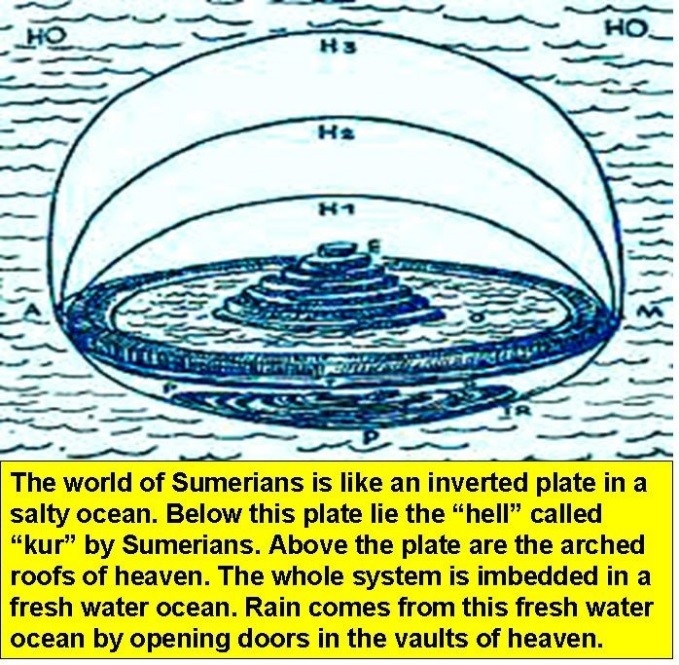
The Sumerian god Anu existed in their cosmogony as a dome that covered the flat-ish earth; Outside of this dome was the primordial body of water known as Nammu (not to be confused with the subterranean Abzu).[1]
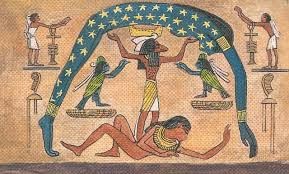
The Egyptians depicted the sky as a side-view arch represented by the goddess Nut.
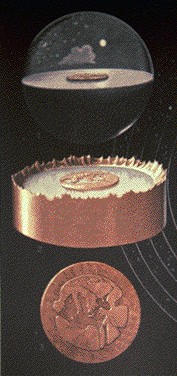
The (early) Greeks had a similar concept of an enclosed, circular world.
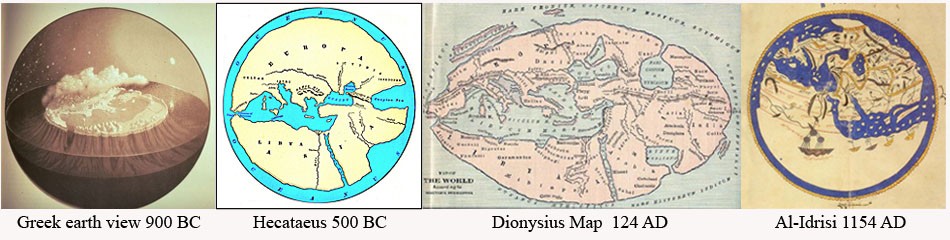
The Norse mythology shared a similar concept:
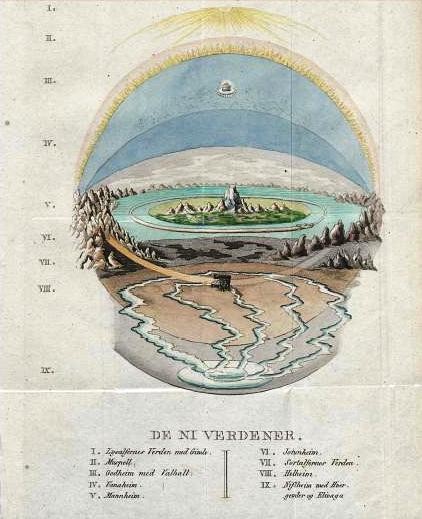
Here is the Irish megalithic rock art symbol for the firmament:
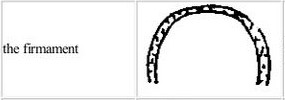
The Mayans, Incas and Navajos likewise viewed the cosmos as:
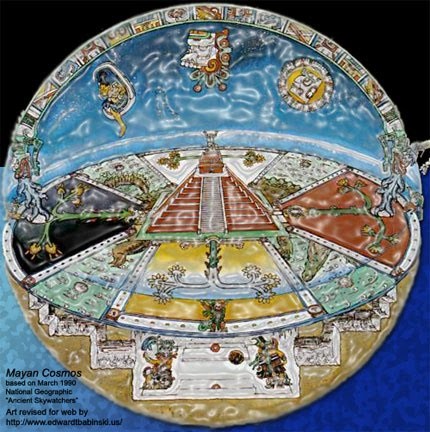
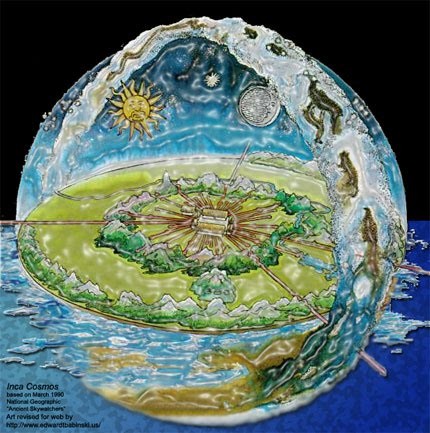
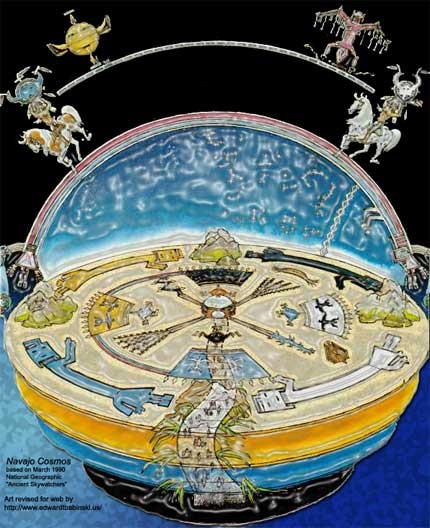
Indeed, this concept shows up over and over again in the ancient literature of numerous cultures (including the Hebrews) as well as in the artwork inspired by such writings.
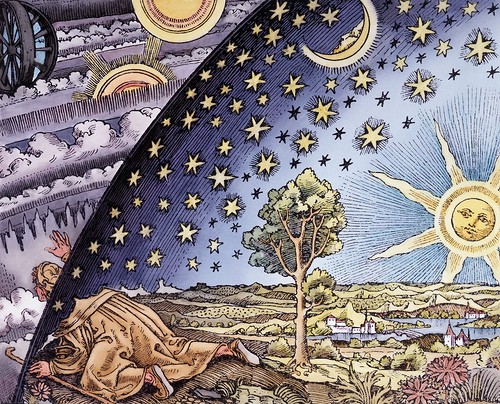
Like it or not – believe it or not – there can be no doubt that the ancient Hebrew concept of the cosmos was precisely as depicted by the scholars of Logos Bible Software (even though they personally do not believe this model to be true):
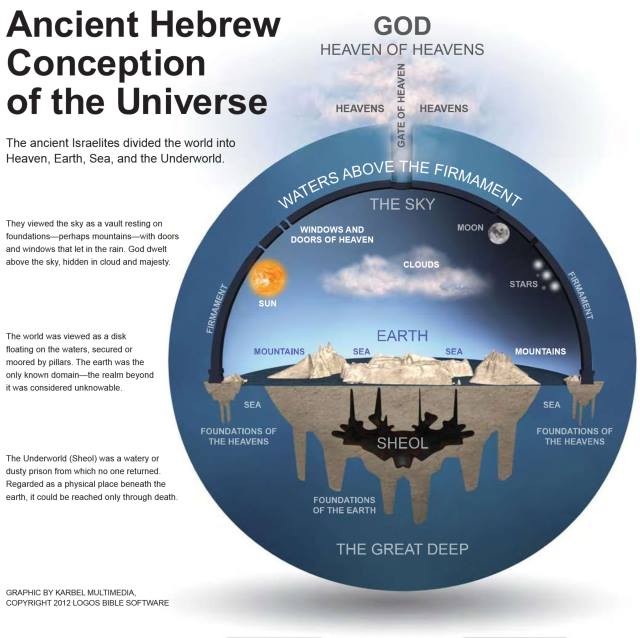
YHWHs’ throne sits above the heavens (waters):
The sun, moon and stars are in the firmament {and the stars shall fall to Earth}:
There are “floodgates” (windows) in the firmament:
Gen. 7:11; 8:2; 2 Kings 7:2-19; Mal. 3:10
The Earth is inscribed in a circular (flat-ish) fashion into something with 4 corners and surrounded by water:
13:5; 40:22; 41:8-9; 44:24; Ezek. 7:2; Dan. 4:10-11, Zech. 9:10; Matt. 4:8; 24:31; Rev. 7:1; 20:8
Earth is a geocentric, stationary world set on pillars:
There is a great on-line resource that shows the Hebrew, Greek and English texts as colorcoded verses. This makes it easy for those of us who don’t know Hebrew or Greek to see which words correspond to each other by color. You can then dive deeper and use other resources to further define the words for you. When you use this color-coded website for Genesis 1, this is what you will find concerning the firmament:
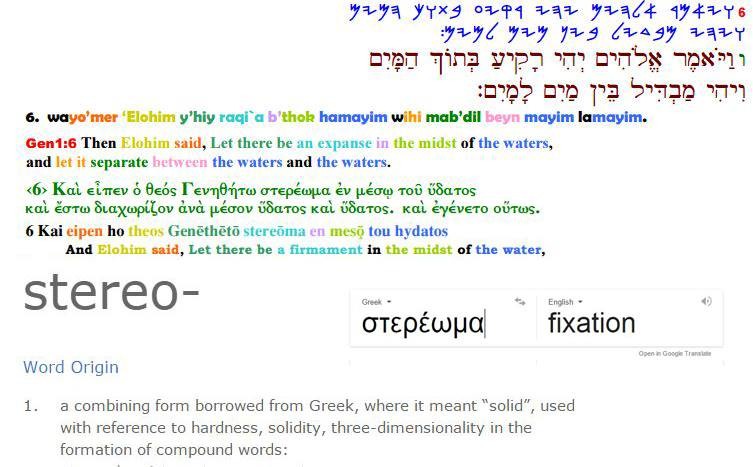
As you can see in the above graphic, looking at the corresponding words for the firmament, then using an on-line translator and dictionary to discover the meaning of the Greek word “stereoma,” which the HEBREW scholars chose when they translated their Hebrew text into Greek. The word they chose conveys the meaning of something SOLID.
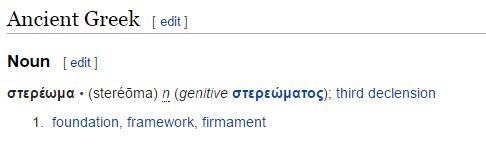
No surprise there. The book of Job predates Genesis, and it just comes right out and tells you the sky is indeed firm. It’s not just some expanse of gas, eventually leading to the ever expanding vacuum of space.
Job 37:18 Hast thou with him spread out the sky, which is strong, and as a molten looking glass?
A “molten looking glass” as the KJV puts it was an ancient mirror made from beaten down metal. This is likewise confirmed in numerous English translations:
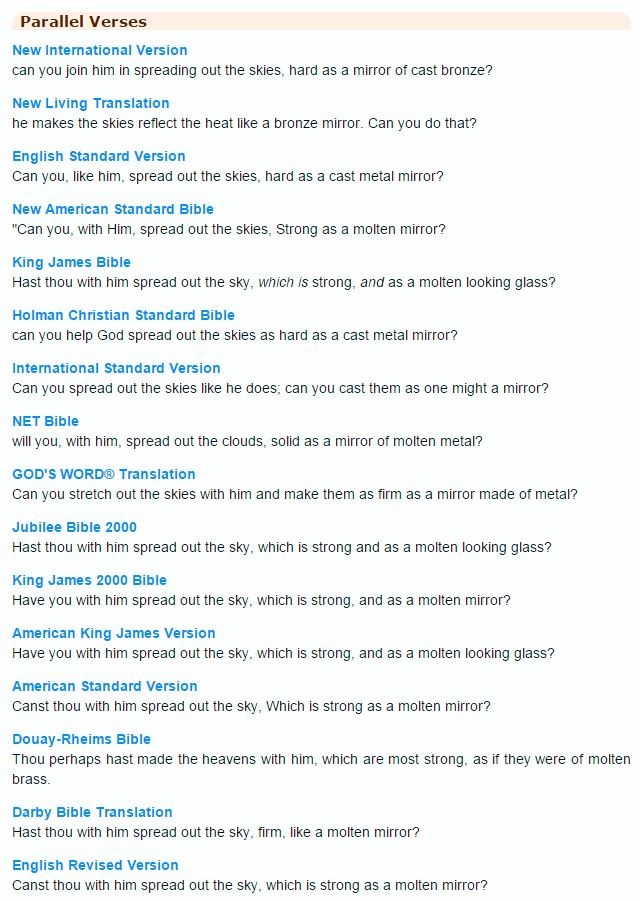
The KJV and others say that the sky is “strong.” Others say “hard.” Why? Because the Hebrew word used here is “chazaq” which means:
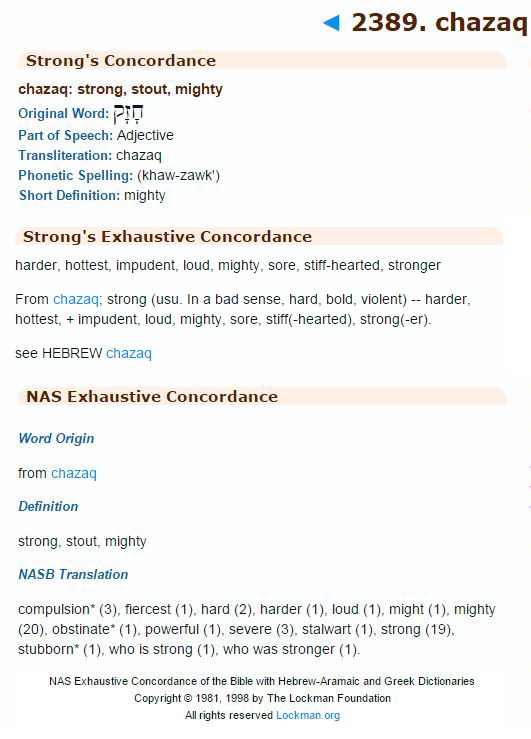
The color-coded site entry for this Scripture reveals…
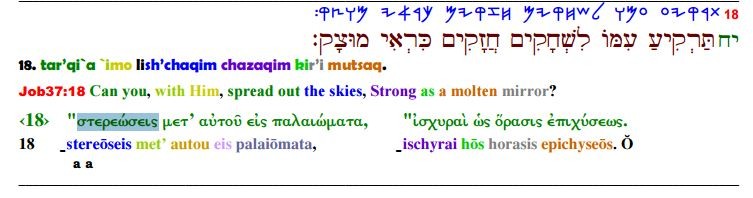
Here we see that the HEBREW scholars, chose the Greek word “stereóseis” as the word they used for the sky. This is a word used to describe something that is “fixed” in place…
The Greek word they chose for “strong” is “ischyraí,” which means potent. Potent is an English word, which means…
So, here we have the Hebrew scholars, conveying through the Greek text something that is powerful and mighty, which is fixed in place. How can you twist and manipulate that into any plausible description of gaseous air and the vacuum of space?? That’s wishful thinking of the highest order if you ask me.
Even the on-line resource, BlueLetterBible recognizes the Hebrew word “raqiya” as meaning something that was considered strong, firm and quite solid:
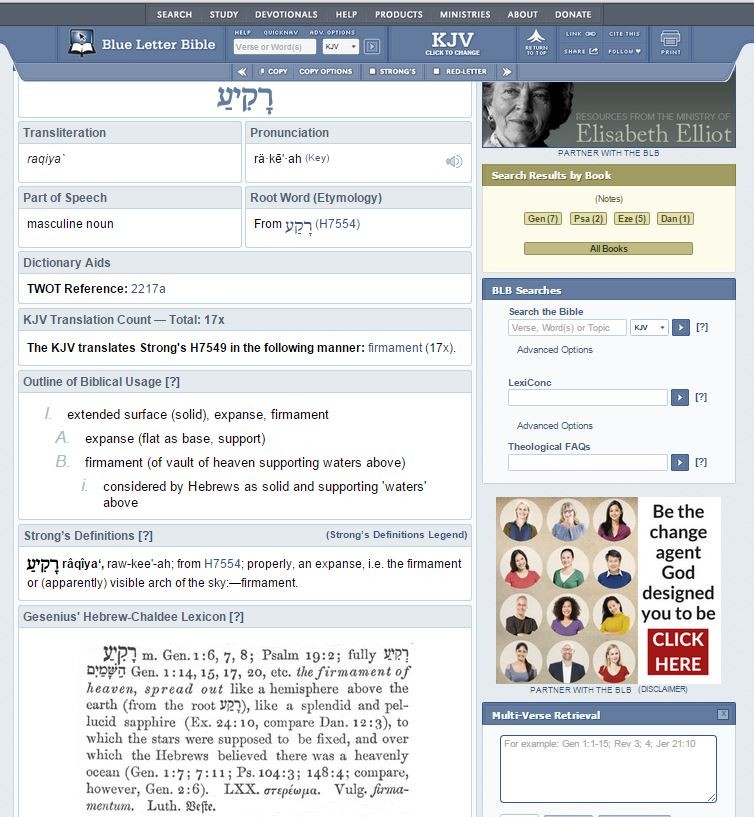
You’ll note also that the word “raqiya” comes from the word “raqa” (Strong’s # 7554), which does mean an “expanse” …but one that is “stretched” and “beaten out” as metal.
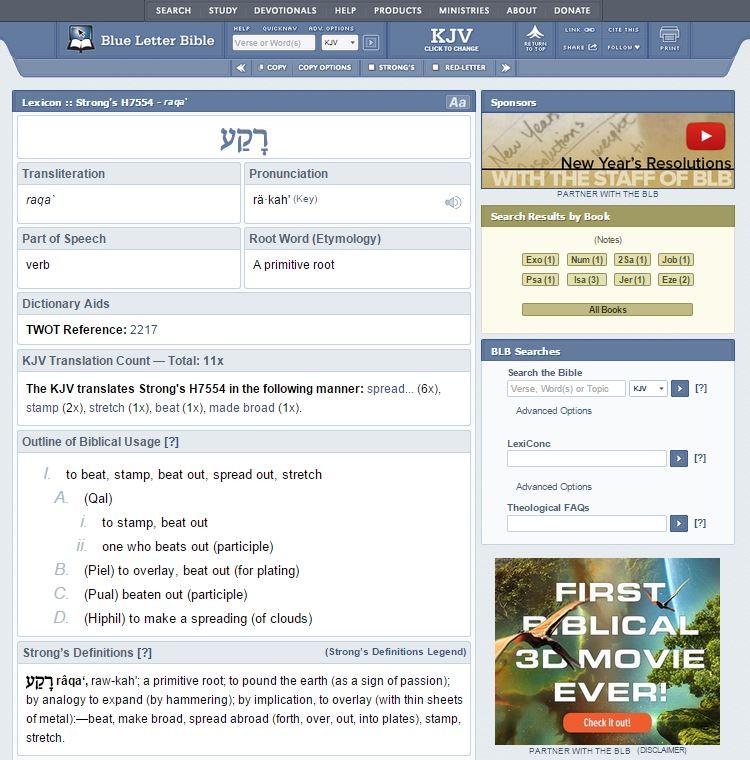
The word “raqa” is used 11 times in Scripture. And if we were to go by the “Law of First Mention” principle, we first see it used here:
Exodus 39:3 And they did beat the gold into thin plates, and cut it into wires, to work it in the blue, and in the purple, and in the scarlet, and in the fine linen, with cunning work.
In fact, in all 11 cases where the word is used, it is in reference to stamping, beating, and stretching out something firm! In no way does the root word for firmament therefore even remotely support any notion of air and space. How do you beat and stamp atmospheric gas and a vacuum!?? No. Indeed, if we return back to Job, the explanation is made quite plain for us.
Job 37:18 Hast thou with him spread out the sky, which is strong, and as a molten looking glass?
Here Job backs the claim that the sky (i.e. the firmament) was “spread out” (raqa) as a molten looking glass, which becomes like a mirror from having been beaten (raqa)!
Sorry Charlie. But there is simply NO WAY you can force the “raqiya” in Hebrew or the “stereoma” in Greek – i.e. the “firmament” in English – into anything even remotely resembling the atmosphere and the vacuum of space. Nice try, but that’s just wishful thinking at best and totally delusional at worst. As for the etymology of the word “firmament,” again we see this idea of something that is “fixed” into place:
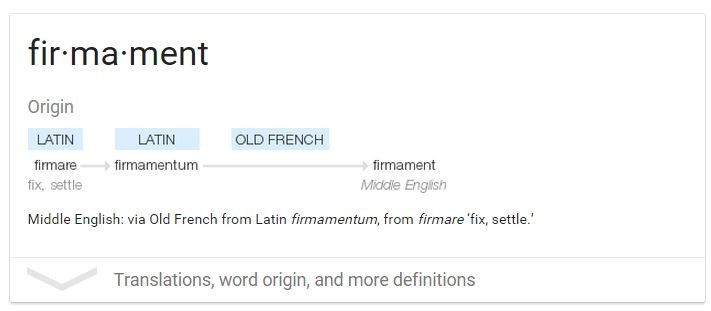
Indeed, there is a reason why the ended up with the word FIRMament in our Bible and Wikipedia actually provides us with some great information concerning its history…
In Biblical cosmology, the firmament is the structure above the atmosphere, conceived as a vast solid dome.[1] According to the Genesis creation narrative, God created the firmament to separate the “waters above” the earth from the “waters below” the earth.[2] The word is anglicized from Latin firmamentum, which appears in the Vulgate, a late fourth-century Latin translation of the Bible.
Biblical use
Main article: Biblical cosmology
The firmament is described in Genesis 1:6–8 in the Genesis creation narrative:
Then God said, “Let there be a firmament in the midst of the waters, and let it divide the waters from the waters.” Thus God made the firmament, and divided the waters which were under the firmament from the waters which were above the firmament; and it was so. And God called the firmament Heaven. So the evening and the morning were the second day.[3]
Etymology
The word “firmament” is first recorded in a Middle English narrative based on scripture dated 1250.[4] It later appeared in the King James Bible. The word is anglicised from Latin firmamentum, used in the Vulgate (4th century).[5] This in turn is derived from the Latin root firmus, a cognate with “firm”.[5] The word is a Latinization of the Greek stereōma, which appears in the Septuagint (c. 200 BC).[1]
History
Main article: Hebrew astronomy § Biblical cosmology

The Flammarion engraving (1888) depicts a traveler who arrives at the edge of a flat Earth and sticks his head through the firmament. The word “firmament” is used to translate raqia, or raqiya‘ ( רקיע), a word used in Biblical Hebrew. It is derived from the root raqa‘ ( רקע), meaning “to beat or spread out”, e.g., the process of making a dish by hammering thin a lump of metal.[5][6]
Like most ancient peoples, the Hebrews believed the sky was a solid dome with the Sun, Moon and stars embedded in it. [7]According to The Jewish Encyclopedia:
The Hebrews regarded the earth as a plain or a hill figured like a hemisphere, swimming on water. Over this is arched the solid vault of heaven. To this vault are fastened the lights, the stars. So slight is this elevation that birds may rise to it and fly along its expanse.[8]
Augustine wrote that too much learning had been expended on the nature of the firmament.[9] “We may understand this name as given to indicate not it is motionless but that it is solid.” he wrote.[9] Saint Basil argued for a fluid firmament.[9]According to St. Thomas Aquinas, the firmament had a “solid nature” and stood above a “region of fire, wherein all vapor must be consumed.”[10]
The Copernican Revolution of the 16th century led to reconsideration of these matters. In 1554, John Calvin proposed that “firmament” be interpreted as clouds.[11] “He who would learn astronomy and other recondite arts, let him go elsewhere,” wrote Calvin.[11] “As it became a theologian, [Moses] had to respect us rather than the stars,” Calvin wrote. Calvin’s “doctrine of accommodation” allowed Protestants to accept the findings of science without rejecting the authority of scripture.[11][12]
So in conclusion, it’s probably best to completely ignore those “scholars” who want to tell you that we should just dismiss the whole Biblical model of a flat-ish Earth under a dome thesis as nonsense and embrace the ridiculous notion that the word “firmament” can simply mean clouds, atmosphere and space. Anyone who subscribes to such a notion is completely delusional and they are choosing to remain willfully ignorant of well established, historical facts, not to mention the understood meanings of words like “raqia” in Hebrew, “stereoma” in Greek and “firmament” in English.
Circle Means CIRCLE – NOT Ball/Sphere/Globe!
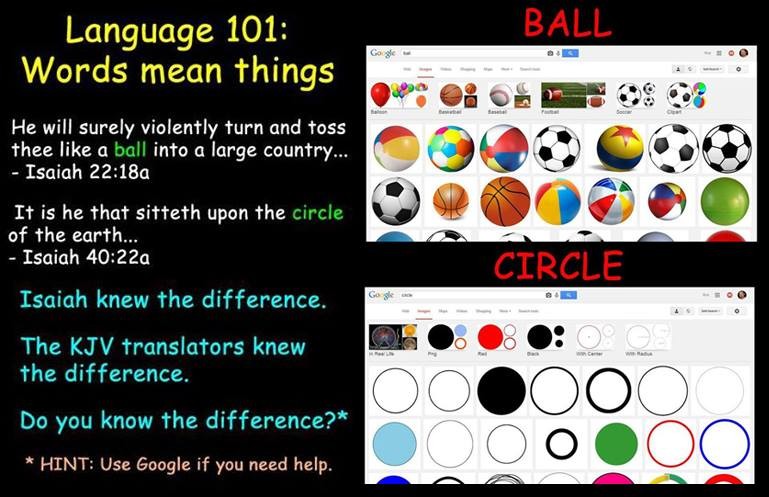
As the above graphic shows, Isaiah knew the difference between a ball (sphere) and a circle – and so did the KJV English translators. Speaking of, {a-hem} we must point out that KJV only types need to take note because you are contradicting these “inerrant” 1611 scholars by forcing them to agree with notions of a spherical Earth versus what they actually stated – i.e. that it is a circle. You can’t do that. By your own dogmatic (psychosis) you demand that it is a “perfect translation.” According to you, it has absolutely no errors! Remember, YHWH Himself “preserved His word” (7 times we’re told) through these men and through them alone. Therefore, you can NOT twist their 1611 circle into a sphere! They obviously knew the difference between a ball/sphere/globe and a circle and being brutally honest with the text, they chose to translate it as circle.
Now let’s look at the words Isaiah used in Hebrew. I know KJV only types hate that, but believe it or not, the Scriptures didn’t originate in English. The “perfect” 1611 scholars, derived their English from the Hebrew, Aramaic and Greek texts. So, we should be able to do the same. In Isaiah 22:18, we find the first use of the word “dur” (ball) in the Scriptures:
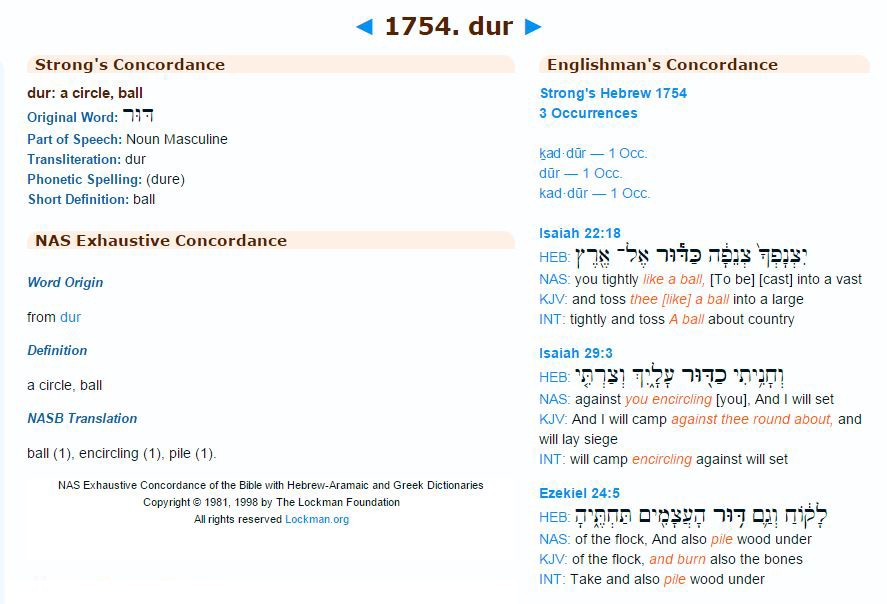
As you can see, the same word shows up 2 more times: once more in Isaiah (29:3), describing someone completely surrounded and again in Ezekiel 24:5, describing something rounded like a pile or a mound set up for burning. The word carries the meaning of something spherical-like in nature (or as in Isaiah 29:3 as something that is all around you).
Whereas, the word in question (“chug”) concerning the Scripture’s description of our world is defined as:
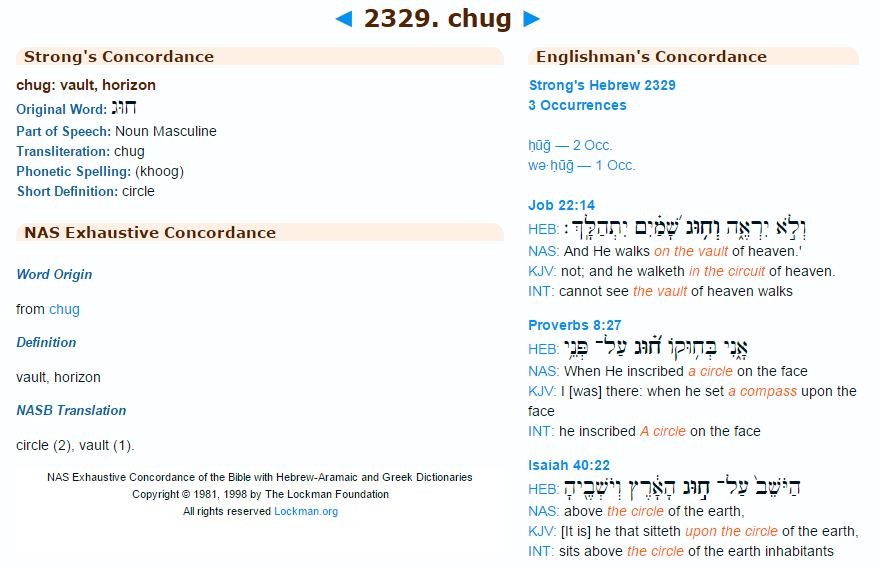
Once again, we have a word that is only used only 3 times in Scripture. But let’s apply the “law of first mention” to see how it was initially introduced to us in the Bible:
Job 22:14 Thick clouds are a covering to him, that he seeth not; and he walketh in the circuit of heaven.
Is YHWH walking on a sphere or a “circuit” up there? Well, what is a circuit? The dictionary defines it as:
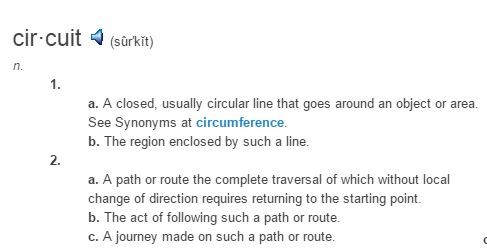
It is a circular path. I see no mention of anything in that, which would demand a definition of a sphere.
YHWH is walking on a circular path.
Then we come to Proverbs and Solomon describes how the dry land “appeared” in Genesis 1 by saying:
Proverbs 8:27 When He prepared the heavens, I was there: when He set a compass upon the face of the depth:
Set a compass on the face of the deep? What does that mean? This?

Well, no… not exactly. Although it is interesting that a compass is used to draw a circle, which is what Isaiah later describes. In the KJV, we aren’t really getting the full picture. It just says “set a compass,” but in the Hebrew, the word used for “set’ is:
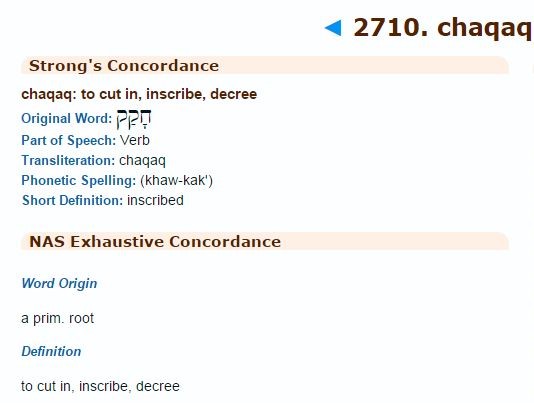
What was inscribed? A “compass?” Well… Solomon used the same word Isaiah did for circle (Isaiah 40:22′ “chug”). Ahhhh… OK. So now we’re getting somewhere. Isaiah’s “circle” was – according to Solomon – inscribed into something! Here are a few other examples of how this word “chaqaq” was used (by Isaiah):
Isaiah 22:16 What hast thou here? and whom hast thou here, that thou hast hewed thee out a sepulchre here, as he that heweth him out a sepulchre on high, and that graveth an habitation for himself in a rock?
Isaiah 49:16 Behold, I have graven thee upon the palms of my hands; thy walls are continually before me.
With the above in mind, we find that the New American Standard Bible gives us a clearer rendering of Solomon’s words based on a more accurate representation of the Hebrew word “chaqaq”:
Proverbs 8:27 When He established the heavens, I was there, When He inscribed a circle on the face of the deep,
Or in the King James 2000 Bible we see:
Proverbs 8:27 When He prepared the heavens, I was there: when He drew a circle upon the face of the depth:
How do you inscribe or draw a ball into something? You can’t. No. In each of these cases, we are talking about a circle. According to the Concordance, the Hebrew noun “chug” comes from the verb form of the same word:
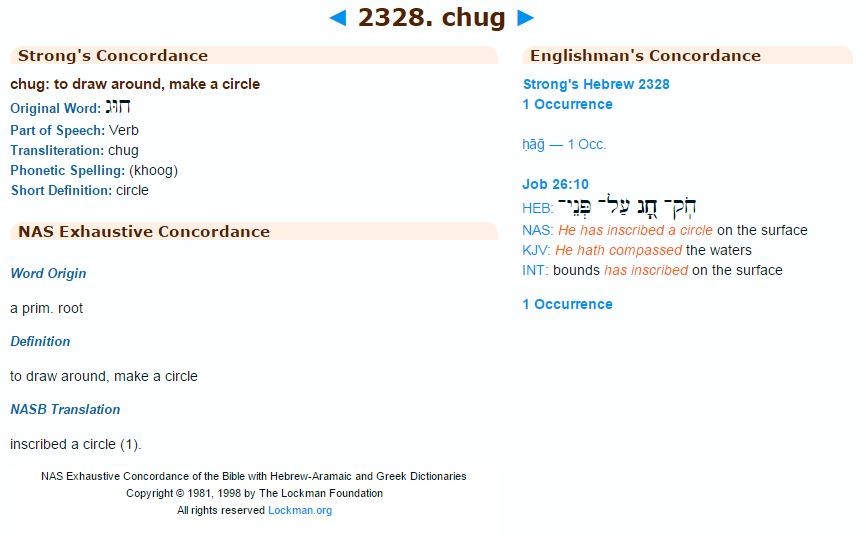
Note, that this form is used only once, in the first book of written (canonized) Scripture:
Job 26:10 He hath compassed the waters with bounds, until the day and night come to an end.
What does it mean to have “compassed the waters”?

In every single case, the word “chug” is used (both as a noun and a verb) to describe something circular, not spherical!
Job 38:14 It {the Earth} is turned as clay to the seal; and they stand as a garment.
Backing up to the previous verse, we see:
Job 38:13 That it might take hold of the ends of the earth, that the wicked might be shaken out of it?
Where are the “ends of the Earth” to take “hold of” on a ball? This description fits perfectly with a circular Earth, which is pressed as a seal though. This is clarified a bit more in the English Standard Version:
Job 38:14 It is changed like clay under the seal, and its features stand out like a garment.
Get some wax and a seal. Press the seal into the wax and you will get the picture: you end up with a circular, pressed flat seal with raised features on it.
And… LOL! Please don’t even try to use the KJV’s use of “turned” to try and “spin” some notion of Biblical support for the Earth’s rotation/orbit. Please – don’t. The universe is begging you. The Bible consistently describes this place as stationary and firmly set on pillars.
“Circling” back around to Isaiah 40:22, the last and final (Biblical) use of the word “chug,” there is simply no way you can force it into meaning a sphere.
Like it or not, believe it or not, accept it or not, YOUR, OUR and/or THE Bible Given to us all by the One and Only Great God YHWH is a flat-ish Earth book! Deal with it however you must, but don’t try and force it to say something it absolutely does not even remotely support. Thus, for the love of all that is Holy, sane and true, please stop listening to bogus translations that justify a spinning, heliocentric, globular Earth!
The dots are many, and after even the most brief considerations of each or any of them, one can only conclude that once again, we have all been LIED to by the enemies. Not even fools would argue otherwise, indeed the only ones YOU will find arguing for the spinning ball or a totally flat Earth, are your enemies. Enjoy your sanity, God Gave it to all of us originally, and only the true fools among us will remain deceived and destined to burn in Hell for Eternity!